
Dear Omondi Ochuka,

When I began writing this review, I reached out to my friend Salvin — writer and editor extraordinaire — for advice. He felt like the person to talk to about how to give Precursor a befitting review.

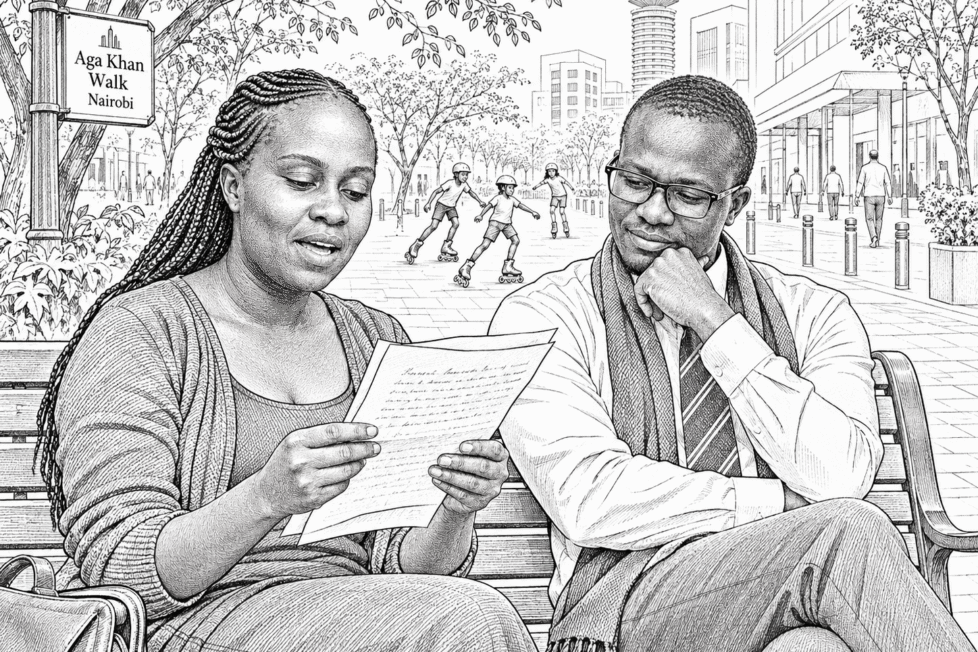
One of the insights he shared was that I write the review as though I was talking to a (my) friend about the book. This is in part why I’m here, writing to you — not as a review per se — but as a conversation with my friend about Precursor, even when that friend is the author of Precursor.

Is it possible to separate (the) art from the artist, the artist from the art they make?

This question pops up often, especially when characters in fictional work takes stances on pertinent sociopolitical issues, and questions are asked as to whether the writer holds similar positions. In nonfiction, the question is doubly confounding.

My question, the one I keep circling around is whether you can separate the artist from their art when the book is about their life and experiences. I returned to this question every time something in Precursor gave me pause, especially when the heart of it was the weight and magnitudes of the violence life has inflicted on you. The part of me that now calls you my friend is in part why it took me as long as it did to read you. The rest I might attribute to my determination to be wholly affected by your work; something I have carried with me since I started reading you last year. It feels like I have been here much longer than that though.

I binge-watched Off Campus last week. In one of the episodes, one of the characters who’s in college to become a musical composer enrolls in a contest, one that requires she make pop music. She’s insistent she can do it even when her specialty is classical music. When she stumbles upon challenges in this pursuit, her advisor asks that she shifts her focus from the technicalities of the process itself and onto how listening to her favourite pop songs has made her feel instead.

Might that be the heart of art as a collective? How books, music, art, dance, film, movies make you feel? The feeling you’re left with after watching a darn good film, one whose lighting and costume choices you can’t explain, but one where you know just how certain scenes sat themselves in your heart, wouldn’t leave and left you warmer for it?

I read Precursor over a period of six months, you wrote the book in years.

I’m a fast reader, I’ve been known to make it through entire books in a day; I read the entire Harry Potter collection in a month. Precursor is not the kind of book one rushes through. It asks one to sit with it, allow yourself to be affected, slowly, essential. The kind of book you pick up, read, allow beautiful necessary ruin, put it down then return to it at your own heart.

When I made it past the 400-page mark, I started to carry this weight in my chest, I didn’t know what was going to happen to me when I finally got to the end. The day I finally did, that particular moment when I closed the book after reading “The end; a beginning.” I felt a loss I still haven’t been able to put into words, adequately.

I read you almost obsessively, you know this. This is important because I haven’t known how to separate writing about Precursor and all the other work that you put out, you really. All your work at this point has blended into one whole that’s just you and the effect the work of you continues to leave on my being.

You reference that you carry a hunger that much like Kafka’s, and that it drives the writing, in part. I see it. I have seen it throughout the time I have been reading you.

That hunger bleeds through everything you write, healthcare articles, activism articles, articles delving deep into policies and the economics of healthcare and a country that continually fails its people all the while there are frameworks ready for implementing. You don’t mince your words, and it’s one of the things I admire the most about your work.

Reading you has become a return to revelation of hungers I didn’t know I had and those I was in awareness of, didn’t yet realize just how deep they ran until I was reading you and there I was, face to face with something I’d long resigned myself to seeking out in fiction. It is for this reason you calling your work “Necessary Non-fiction” continues to feel so monumental.

You wrote to me a while back, to say that I experience art in a manner similar to the tending to physiological hungers – with the expectation that it might build new bone. I wrote back to say you write like a madman.

A more correct diagnosis, one perhaps closer to the pulse is you write like a dying man that needs writing, needs words as oxygen for lungs struggling to breathe. A drop of water, salvation in scorching mean-making desert heat.

The first of your articles I remember destroying me beautifully was about diary and letter writing. I remember crying reading it not because of its inherent sadness, just that finger on the pulse I found it to be revealing in nature. You had written about writing your daughter since before she was born and I was having this desire and longing I had carried whilst pregnant, just wanting to write him read back to me.

I find that I need reason for things, back then I didn’t know why I couldn’t stop wanting to write my unborn child; I wrote him for the first time that day, he was almost 5 then.

In Precursor, you circle around introspection and your search for meaning through illness. You also write around it in a manner that makes me question whether you were born hungry, curious, looking for meaning to feed your hungry soul even before you realized you were doing so. What with your gravitational pulls towards your grandparents and uncles — people much older than you?

Palm reading? You came into the world with an innate hunger and curiosity, one your life experiences has deepened. And I’m personally incredibly grateful for it.

The individual story matters, solitary and in the register of the stories we tell ourselves about the collective.

Could this be what makes your work dangerous? Because it has taken a particular courage to stay with the things your work draws out of me.

It wouldn’t be easier to go back to resignation of tending to that hunger, but there are ways life might be simpler if I didn’t commit to the searching, you know?

At some point, I began walking towards your work with a certain trepidation, it was also then that I knew I would keep returning, the same revelation that gives form to ‘there’s no such thing as enough books.”

A question you pose about morality in line with euthanasia and suicidal ideation stayed with me. Allow me to use my thoughts here with thoughts from one of your articles, in part.

I have been suicidal for long periods of time, and I often think the violence of a mind that does not want to continue, one that perceives death — inexistence as better than continuity — is not one I’d wish on anyone.

Conversations about this often drift to the morality of it: who gets to decide whether an individual can take their life, and is it okay for the individual to make that decision?

Power as we understand it now makes any arguments for morality in that place moot does it not? In the context of chronic illness, bodily pain and mental anguish are not the only thing to account for, there are also systems, ones that continue to make life impossible for a lot of folk.

I know there has been work to decriminalize suicide here in Kenya, but with that said, is the question about the morality of suicide/ euthanasia in direct relation to human life — especially one in the violence of chronic illness — the right one? Shouldn’t we, in the very least, account for the dignity of human life?

I find myself returning here: that whether you are writing about your childhood, navigating illness and the intricacies of it, life experiences, the whole wide expanse of them, the heart of it perhaps is a humanizing of self in truth and honest accounting for a lot of the ways life functions. And the manner in which dysfunction, be it family, a sick body, systems that are exploitative and ruinous, the heart of it for me reads through the human being experiencing it. And the attention they are giving to their life, the manner in which their actions/inaction affects not just them but others too, bringing along introspection, how better and truer to being can one be?

We argue for morality as bound to the sanctity of human life, but what becomes of the conditions, such as poverty, hunger, illness, war, greed, societal rot, violence, capitalism, that rob many of the dignity of human life. These conditions, if we fail to account for them, render certain arguments about morality almost irrelevant.

Precursor gave form to the manner in which a constant reimagining of life and the nature of those returns is a lifelong endeavour. You are ahead of time in conversations about cancer, rendering Precursor more than just an illness memoir, I am in awe of the ways you threaded thoughts and invitations to conversation about what we owe for the self, and one another. That once you look at self, really confront your existence truly, you cannot then be blind to that of the person next to you. In the ecosystem of memoirs about power, Precursor exists as an argument for the self.

What do we do in the face of dysfunction: be it individual, familial, societal or political?

Allow me to borrow a part of your story here.

You write about being born out of wedlock and being raised by your grandparents. In this register, there is what is happening to you in childhood and deeper into adulthood, the questions you carry and questions that remain unanswered. There is accounting for the secrecy within the family and the weight of it. Outside the family, there were kids who leverage your story and use it against you. All these things are happening individually and concurrently.

Dysfunction such as this is often treated and a personal or moral failing.

Do we owe children answers?

Are we as adults owed correct histories and information to aid in moving about the world? Once those questions present and the answers in turn fail to be satisfactory, what ought to come after?

You write a lot around healthcare systems in the country, SHA/SHIF, a public health insurance framework created with the promise that it would work and the manner in which it works now. At the onset of the 2024 protests spurred by the finance bill, we saw plenty of civic education about what we’re owed, by the government and what the taxes we pay ought to deliver.

Kenyans died, others crippled. Lives changed forever changed, yet still, the powers that be continue to persist in their preassigned capacities without fully accounting for and being held accountable for the effects of systems curated to keep causing harm.

And so, the stories we tell ourselves about the world, what our histories tell us about life as we know it, how better we can move about life. Throughout Precursor, you amplified the necessity of the self in conversations and narratives about power.

You mourn the loss of essence that came with translating some of your writing from Luo, I found myself reading the bits of it in your mother tongue out loud, every word, even when I didn’t understand it. A fidelity to the ways it feels truer to texture, even your music, the rap entirely in Dholuo feels this way somehow.

This drew me into reimagining healing and wellness in the lens of the knowledge our ancestors carried, with nutrition and traditional medicine. Essential in conversations about healing, contextually, even broadening research that caters better to the African body. What was destroyed by colonization that might hold better answers for wellness, for the indigenous body and mind.

The questions we ask about self don’t only reveal truth about us, Precursor is a much needed reminder that they serve to reveal substance of the world around us. It is essential to reimage healing and wellness, all whilst catering to whatever information and contextual complexities that might broaden our understanding and enrich the quality of our lives.

I wouldn’t write you properly without touching the heart of you: Dani Marie. You write your grandmother with a devotion and attention that brought back memories of my paternal grandmother I had buried owing to the circumstances surrounding her passing. I found myself returning to my maternal grandmother’s home multiple times even when I had been hesitant owing to how difficult caregiving her has become the past couple of years, what with her old age and resistance to people taking care of her.

You write her philosophies beautifully simple and complex to the point I sometimes wonder how many of them are hers and how many are yours?

I do not dispute her wisdom. Madam Marie colours complex philosophy so delicately that walking away unaffected is impossible, and if somehow one succeeded, it would be unfortunate. I smile every time I hear someone say Erokamano because the meaning of it now carries in Marie Ochuka’s register, one that has given our gratitude character and grace.

Could it be that in your learning at her feet you became (have become) this very grace and philosopher? That in your companioning each other’s journeys you became her, that her love and truths embedded themselves so deep in your being, that her philosophical graces have become simply, wholly yours and now in a season where her memories are altered living with dementia, we can bask in her grace through you?

After I finished Precursor, I wrote to say I had finally found a name for what I’d been moving about and through the world carrying. The substance of which I hadn’t found a name for until I was reading you.

You found me in this profound loneliness. I read you and it dissipated some. I read you and your hungers translated mine back in ways I didn’t yet know possible. I have read you and you have devastated me, in the beautiful way that leaves me utterly truer at being for it. My returns I attribute to the plain truth that not reading you would be forsaking life in a form I have only dreamt and imagined possible in universes that aren’t this one I currently inhabit with you.

Thank you for Precursor, Omondi Ochuka.

Thank you for being.

Thank you for the work of you.

Wanjiru.


***

You can get a copy of Precursor on Nuria Kenya.

Sign up to receive the most diverting fiction, essays, analyses and news across Africa in your inbox, on Monday every week.

We don’t spam! Read our privacy policy for more info.

Check your inbox or spam folder to confirm your subscription.