
Bonface Orucho, bird story agency

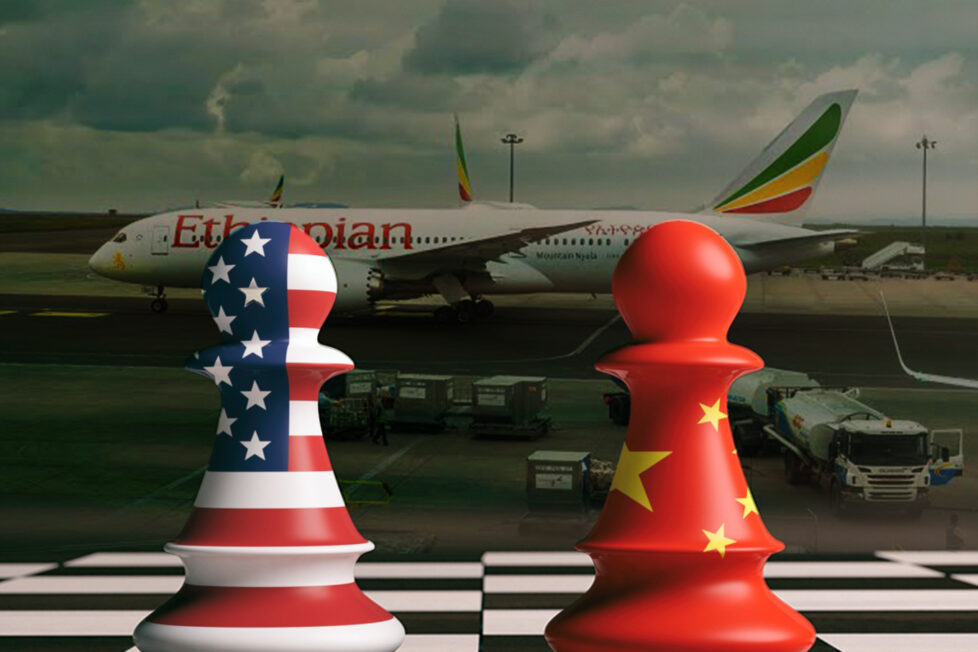
The United States is pushing its aviation companies and technology into Ethiopia’s US$12.5 billion Bishoftu airport, while Chinese firms dominate the shortlist to build it.

The contest is drawing in lenders from the US, China, Europe, the Middle East and multilateral institutions as Ethiopia builds a new hub for its fast-growing national airline.

Work on the four-runway airport, about 45 kilometres southeast of Addis Ababa, began in January.

Ethiopian Airlines, which is developing the project, has allocated US$610 million for earthworks. The airport is expected to open in 2030, with an initial capacity of 60 million passengers a year and eventual capacity of 110 million. It will have space for 270 aircrafts.

The size of that market is one reason Washington wants in.

Bishoftu will become the new international hub for Ethiopian Airlines, Africa’s largest carrier, as Bole International Airport in Addis Ababa approaches its limits.

US Deputy Assistant Secretary of Commerce for the Middle East and Africa Mark Mitchell said in July that Washington was “closely engaged” in pushing to secure US participation in the project.

He did not identify specific contracts American companies were targeting. But he linked the opportunity to the airline’s aircraft purchases, saying US participation could lead to “more Boeing aircraft powered by GE Aerospace engines”.

The commercial relationship is already large.

In April, Ethiopian Airlines agreed to buy six more Boeing 787-9 Dreamliners, adding to 20 aircraft already ordered.

For US companies, the airport offers opportunities beyond aircraft.

The US Department of Commerce has identified areas including airport infrastructure, engineering, aviation systems, cargo logistics, energy, security and smart-terminal technology.

The US Development Finance Corporation and Export-Import Bank of the United States have also shown interest in financing opportunities connected to the project.

Boeing Africa managing director Henok Teferra Shawl has pointed to opportunities across “airport infrastructure, aerospace manufacturing, talent development & commercial aircraft partnership”.

That puts the airport at the centre of a much bigger aviation supply chain.

But China starts from a stronger position in the construction race.

Ethiopian Airlines shortlisted 33 firms and consortia for four major works packages covering the main terminal, support facilities, airfield and infrastructure works and offsite transport links.

Fifteen of the shortlisted positions are held by Chinese companies or Chinese-led groups.

The list includes China Communications Construction Company, China Road and Bridge Corporation, China Civil Engineering Construction Corporation and Beijing Urban Construction Group.

The US presence in the construction competition is smaller. Lane Construction, a US company owned by Italy’s Webuild, is participating through joint ventures.

The construction contest is still open. Ethiopian Airlines moved the selection of the main contractors to early January 2027 after bidders asked for more time to prepare proposals and arrange financing.

That gives the competing groups several more months to put together technical and financial offers.

Ethiopian Airlines plans to provide 30% of the US$12.5 billion project cost from its own resources. If that structure remains unchanged, about US$8.75 billion must come from external financing.

The African Development Bank is leading that effort.

The bank has been appointed mandated lead arranger and is working to mobilise up to US$8 billion in debt. It has also indicated a potential US$500 million commitment of its own, subject to approval.

The search for money is bringing more institutions into the project.

On September 9, Ethiopian Finance Minister Ahmed Shide and Ethiopian Airlines CEO Mesfin Tasew met Asian Infrastructure Investment Bank President Zou Jiayi in Addis Ababa.

Potential AIIB participation in Bishoftu was among the issues discussed, alongside energy and climate projects. However, no airport financing commitment was announced.

AIIB is a multilateral development bank, rather than a Chinese state lender. But its potential involvement adds another major Asian institution to a project where Chinese contractors and financial institutions are already active.

Ethiopia has also held discussions with China Exim Bank, ICBC, China Development Bank and Bank of China as it searches for external funding.

The financing picture therefore extends well beyond Washington and Beijing.

Lenders from the Middle East, Europe, China and the US have expressed interest, while companies from Türkiye, Italy, France, Qatar, South Korea, Portugal, Russia, India, the US and elsewhere are competing for construction work.

That competition creates room to assemble the financing, technology and contractors needed for the project for Ethiopia.

Upon completion, Bishoftu offers access to one of Africa’s fastest-growing aviation businesses.

Ethiopian Airlines reported a 20% increase in revenue to about US$9.1 billion in the 2025/26 financial year. The carrier has expanded its passenger and cargo network across Africa and beyond, creating pressure for a hub larger than Bole can ultimately provide.

Bishoftu is designed around that expansion. Its 110 million-passenger full-build capacity would be more than four times the capacity of Ethiopia’s existing main airport. It would also place the planned facility well above the roughly 30 million passengers handled annually by Cairo International Airport and Johannesburg’s O.R. Tambo International Airport, currently among Africa’s busiest.

Prime Minister Abiy Ahmed has, in the past, described Bishoftu in January as the “largest aviation infrastructure project in Africa’s history”.

bird story agency

Useful links for editors:
https://www.reuters.com/world/africa/us-seeks-role-ethiopian-airlines-125-billion-airport-project-2026-07-29

Sign up to receive the most diverting fiction, essays, analyses and news across Africa in your inbox, on Monday every week.

We don’t spam! Read our privacy policy for more info.

Check your inbox or spam folder to confirm your subscription.