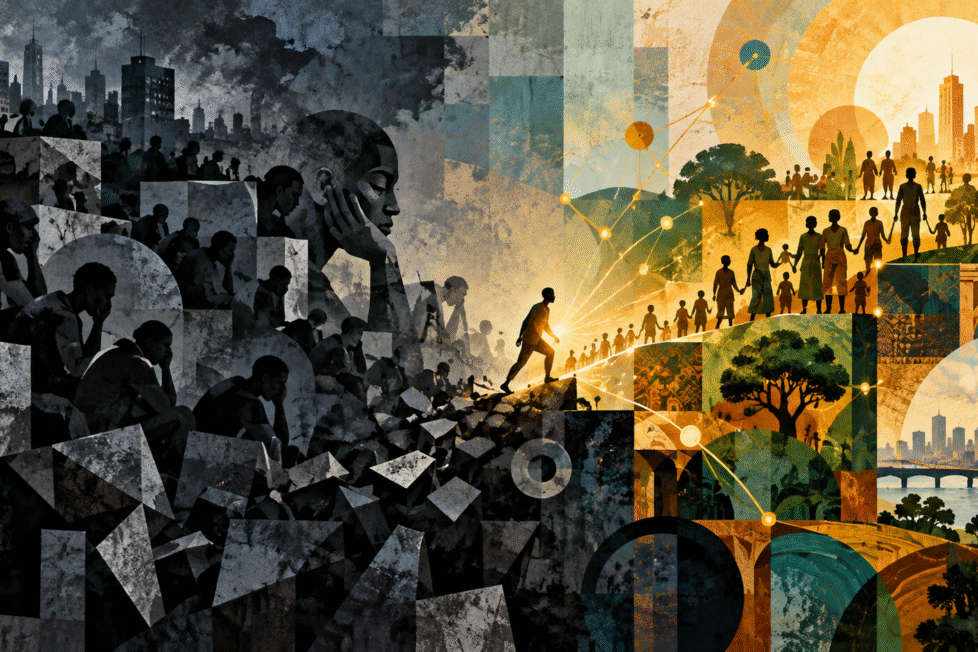

“There is no point. Nothing will change.”

It is a simple sentence. We hear it in conversations, in workplaces, on social media, in communities and sometimes even in our own minds. It can sound like realism, experience or wisdom. But repeated often enough, it becomes something more powerful: a belief that discourages action before action even begins.

Across African societies, where communities continue to face challenges ranging from unemployment and unequal opportunities to inadequate public services, environmental pressures and limited civic participation, this mentality deserves closer attention. The problem is not always the absence of solutions. Sometimes, it is the conviction that solutions are impossible.

When people stop believing that their actions matter, they gradually stop acting.

A person decides not to volunteer because one person cannot change a community. Another does not vote because “politicians are all the same.” Someone sees a problem in their neighbourhood but remains silent because previous complaints produced no visible result. A young person has an idea but abandons it because others tell them that it will never work.

Individually, these decisions may appear insignificant. Collectively, they can create a culture of resignation.

The paradox is that change rarely begins with certainty that an action will succeed. It begins with the willingness to act despite uncertainty.

History offers countless examples of social progress that initially appeared impossible. A community initiative begins with a few people. A local campaign starts with one voice. A volunteer group is created by individuals who simply refuse to accept that a problem is permanent. Not every initiative succeeds. Some disappear. Others encounter bureaucracy, indifference or criticism. But failure does not prove that action is meaningless. It proves that change is neither automatic nor guaranteed.

This distinction is important.

We should not romanticise activism or pretend that individual effort alone can solve structural problems. A person cannot repair an entire road, reform an institution or eliminate unemployment simply by working harder. Structural change requires public institutions, responsible leadership, resources, laws and collective organisation.

But acknowledging structural realities should not become an excuse for personal inaction.

There is a difference between saying, “I cannot solve everything,” and saying, “Therefore, I will do nothing.”

The first is humility. The second can become paralysis.

Africa has a young and increasingly connected population. Digital platforms have created unprecedented opportunities for young Africans to communicate, organise, create businesses,

share knowledge and draw attention to issues that were once invisible. Yet technology alone cannot create civic engagement. A society does not change simply because its people have smartphones. It changes when people decide that their voices, skills, time and choices are worth contributing.

Sometimes contribution is very small.

It can mean helping a student understand a difficult subject. Cleaning a public space. Supporting a local association. Reporting a problem through the appropriate channel. Writing an article. Teaching a skill. Participating in a community meeting. Protecting a natural area. Voting after examining the available choices. Starting a conversation that others were afraid to start.

None of these actions guarantees immediate transformation.

That is precisely the point.

Citizenship is not a transaction in which we act only when we are certain of a reward.

If we volunteer only when we know that our work will produce immediate results, many causes will never receive support. If we speak only when we are certain that everyone will agree with us, important conversations will remain silent. If we participate only when success is guaranteed, we will participate very rarely.

There is also another danger: the sentence “nothing will change” can become socially contagious.

A young person hears it from an older generation. They repeat it to their friends. Their friends repeat it to their younger siblings. Eventually, pessimism begins to look like maturity, while hope is dismissed as naïveté.

But hope without action is indeed insufficient.

What societies need is not blind optimism. They need informed hope: the recognition that problems are real, while refusing to believe that they are necessarily permanent.

The question, therefore, should not always be “Will this change everything?”

A better question may be:

“What can I change, however small, with the resources and position I have today?”

This question changes the relationship between individuals and their communities. It moves responsibility away from an abstract future and brings it back to the present.

One person may not change a country.

But one person can influence a family.

A group can influence a neighbourhood.

A neighbourhood can influence a municipality.

A generation can influence the direction of a society.

Change is often less dramatic than we imagine. It can be slow, uneven and almost invisible at first. Sometimes its most important achievement is not solving a problem immediately, but proving that people can organise around it.

We should therefore be careful with the sentence “nothing will change.”

Sometimes it is a description of disappointment.

Sometimes it is an excuse.

And sometimes, when repeated deliberately, it becomes a tool for keeping people passive.

The answer is not to promise that every action will succeed. That would be dishonest.

The answer is to reject the idea that failure is predetermined.

A society does not need millions of heroes. It needs ordinary people who are willing to take responsibility for the small part of reality within their reach.

The future of African societies will not be built only in presidential offices, parliaments, universities or corporate headquarters. It will also be built in neighbourhoods, schools, associations, workplaces and ordinary conversations.

Every generation inherits problems it did not create.

But every generation also inherits the possibility of responding differently.

So, the next time someone says, “Nothing will change,” perhaps the most important response is not an argument.

It is a question:

“What happens if we try?”

Sign up to receive the most diverting fiction, essays, analyses and news across Africa in your inbox, on Monday every week.

We don’t spam! Read our privacy policy for more info.

Check your inbox or spam folder to confirm your subscription.