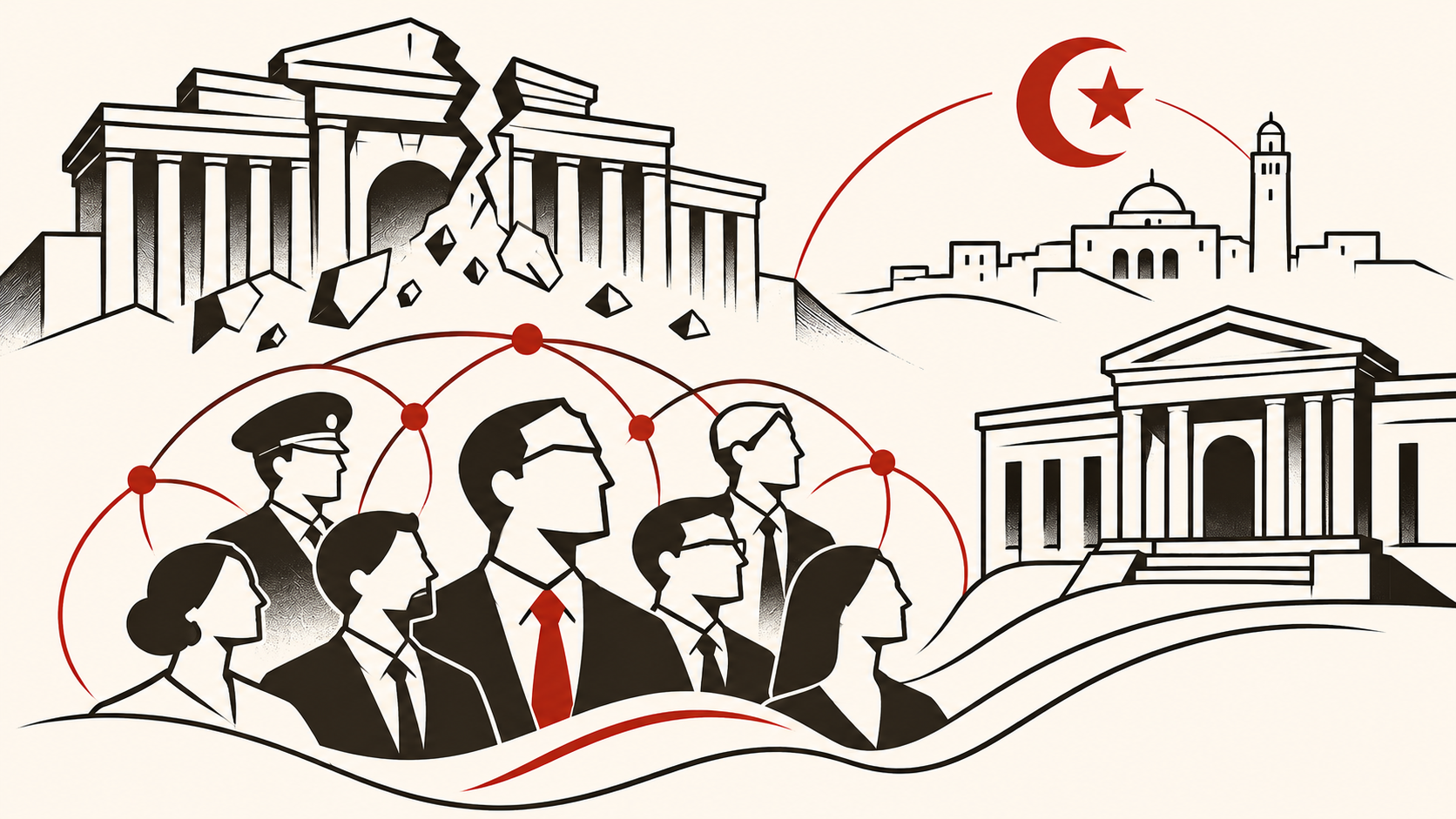

Discussions of political power in Tunisia often focus on the president, the ruling party, the security apparatus, or the government. Yet this approach is insufficient to explain how influence survives the fall of regimes and the replacement of political leaders. Power does not always reside in official positions, and its networks do not necessarily operate entirely within state institutions. There is a broader social structure made up of relationships, interests, privileges, and shared knowledge. It brings together people from different professions and institutional positions who may nevertheless move within the same social world, where their interests intersect.

From this perspective, the former Tunisian regime cannot be understood simply as an authoritarian government that ended with Ben Ali’s departure in January 2011. What matters just as much is the structure that allowed it to endure, the relationships built within it, the people who acquired positions and privileges through it, and their capacity to adapt to the political period that followed.

My central argument is that Tunisia’s elite is not merely a political or economic class. It is a social world capable of reproducing itself. Its survival depends not only on formal authority but also on networks of relationships, patronage, mutual protection, and access to opportunities and platforms that are not equally available to everyone.

The fall of a regime, therefore, does not necessarily mean the fall of the elite that developed under it. Political institutions and public appearances may change while the mechanisms of influence continue within society, finding new ways to operate and adapt.

1. The Elite as a Social Structure, Not Merely a Ruling Class

I do not use the term elite here simply to describe people who hold positions of authority or possess wealth. Having money, a title, or an official position is not, by itself, enough to explain membership in this world. What distinguishes it is access to a network of relationships that provides opportunities, information, protection, and resources unavailable to much of the wider population.

This network can include officials, businesspeople, lawyers, judges, security personnel, civil society actors, journalists, and others. This does not mean that all these individuals belong to a single organization or share identical political views. Rather, their different institutional positions may intersect within networks of interests, patronage, and mutual protection.

The International Crisis Group’s report on Tunisia’s blocked transition examined the relationship between corruption, regionalism, and networks of influence, showing how political, economic, and administrative interests can overlap, and how patronage affects access to resources and opportunities (International Crisis Group, 2017).

This shifts our understanding of power from the question of who governs to a more revealing set of questions: Who has access? Who can protect their interests? Who can maintain their influence even after losing an official position?

The elite, in this sense, is not simply a group of people occupying decision-making positions. It is a social network in which privileges accumulate and circulate through relationships, allowing influence to survive changing political circumstances.

2. Civil Society: An Extension of Some of the Former Regime’s Mechanisms

One of the most persistent problems in discussions of Tunisia’s political history is the tendency to treat civil society as an inherently independent space, or as the natural opposite of political authority.

Civil society under Ben Ali was not a unified space of resistance. It included independent organizations that faced repression, but it also contained organizations that were loyal to the regime or incorporated into its structures. Some of these organizations performed functions that went beyond their declared civil and professional activities.

Zuzana Hudáková’s study of Tunisian civil society explains how Ben Ali’s regime did not merely restrict independent organizations; it also encouraged loyal organizations and provided some of them with privileges and access to state resources. The study describes how certain professional organizations helped members advance in their careers, obtain travel opportunities, and gain access to public-sector clients. These organizations could therefore serve both to distribute privileges domestically and to present an image of pluralism abroad (Hudáková, 2021).

These are not minor details. They reveal that civil society can become a field through which power reproduces itself rather than necessarily a space from which it is challenged.

The former regime benefited from the existence of organizations bearing civil and professional labels, participating in public life, and appearing in international forums, while some of these organizations remained connected to structures of loyalty and privilege. The regime’s external image was therefore not maintained through official propaganda alone. It was also supported by institutions and individuals presenting themselves as representatives of society.

This does not mean that every association was loyal to the regime or that every human rights activist was part of it. Some organizations and individuals genuinely resisted, and they paid a price for their independence. But the existence of this resistance does not erase the presence of another sector that was incorporated into the regime’s structures and used to serve its interests.

Reducing Tunisian civil society to a single image conceals this historical relationship and prevents us from understanding how political authority could benefit from institutions that were supposedly independent of it.

3. After 2011: New Sources of Privilege, the Same Question of Elite Reproduction

After the revolution, the associative sector expanded considerably. New opportunities emerged through international funding, training programmes, travel, conferences, and partnerships with foreign institutions. This represented a significant change from the restrictions imposed under the former regime.

But the question that concerns me is not whether foreign funding is inherently good or bad. It is how these new opportunities were distributed, who had the capacity to benefit from them, and who acquired the ability to represent Tunisian society before international organizations and institutions.

Ragnar Weilandt’s study of divisions within Tunisia’s secular civil society after 2011 examines tensions between different generations of activists, disagreements over practices and priorities, and conflicts surrounding leadership, representation, and mutual trust (Weilandt, 2019).

The study also discusses criticism of the professionalization of activism, including relatively high salaries, professional privileges, travel, and hotel accommodation. The expression “five-star activists” appeared in the discourse of those criticizing this model of civil society work.

These criticisms do not prove that all organizations were corrupt. They do, however, reveal that the associative sector was not free from social hierarchies, competition over resources, or struggles for privilege.

A more important issue emerges here: access to international conferences, travel, funding, and media platforms was not equally available to all activists. Language skills, education, existing relationships, international experience, and the ability to communicate with donors became factors shaping opportunities for visibility and representation.

In her study of civil society’s development during Tunisia’s democratization process between 2011 and 2021, Sabina Henneberg examines changes in the relationship between organizations and international donors. She identifies differences in priorities, as well as a lack of trust and cohesion among activists, as factors explaining the gap between donor expectations and what civil society was able to achieve (Henneberg, 2024).

It is therefore difficult to describe the post-2011 period as a complete break with earlier mechanisms of social selection. Sources of funding and recognition changed, but the question of who could access opportunities, and who could turn civil society work into a lasting professional and social position, remained.

Part of the elite that had operated within state institutions and civil society before the revolution found new spaces in which to rebuild its position after 2011. Recognition no longer had to come exclusively through the ruling party or the administration. It could also be acquired through international organizations, partnerships, programmes, and conferences.

4. The Rite of Passage: Distancing Oneself from the Majority and Entering Another World

I do not believe that membership in the elite is always determined by money, position, or educational qualifications. There is a more complicated social and behavioural dimension: the ability to enter a world governed by rules different from those publicly professed by the majority.

This transition can be understood as a kind of rite of passage. An individual does not enter this world simply by possessing the right qualifications. Entry also involves adopting its codes, building relationships, understanding what can be said and what must remain unspoken, and learning what can be revealed and what must be kept secret.

Within this world, secrecy may become a social resource, while mutual knowledge can function simultaneously as a means of protection and pressure. Participation in behaviours that an individual would not publicly acknowledge may, in some closed circles, become part of a test of trust. The significance does not lie in treating a particular private behaviour as proof of corruption, but in examining how the ability to keep secrets and provide mutual cover may become part of the relationship between network members.

The issue is not to pass moral judgment on people’s private lives. It is to understand the social function of secrecy, complicity, and blackmail. When each party knows something about the others, relationships can become based on mutual dependence, making withdrawal costly.

This is an interpretive hypothesis I propose to understand how belonging to certain closed circles may be established. Its specific mechanisms require independent testimony and documentary evidence. Nevertheless, it raises a question that cannot simply be dismissed: Are some networks of influence based only on the exchange of interests, or does the exchange of secrets and private information also serve to secure loyalty?

5. Mutual Protection: How Does the Network Regulate Itself?

A social network does not necessarily need centralized commands to maintain its cohesion. Personal relationships, shared interests, and mutual knowledge may be sufficient to produce a form of internal discipline.

An individual may receive protection because they belong to a circle of interests, or because they have relationships that provide access to an official, judge, lawyer, or businessperson. Such influence may continue even after the individual loses an official position.

But protection is not necessarily permanent. Relationships may change when one party’s interests conflict with those of others, or when someone moves outside the group’s accepted rules. At that point, the individual may lose the protection they once enjoyed. Information that was previously kept secret may become a means of pressure or public exposure.

The International Crisis Group’s report on Tunisia shows that networks of patronage and corruption do not operate solely through the exchange of money. They also rely on relationships of solidarity, shared interests, and the ability to protect individuals within and beyond administrative institutions (International Crisis Group, 2017).

This helps us understand the elite as a network that extends beyond professional boundaries. People from institutions that appear formally opposed may nevertheless intersect socially and economically in private spaces.

The presence of individuals from different professions in the same social setting does not, by itself, establish the existence of an organized network. It does, however, raise questions about the relationships connecting them and whether those relationships generate mutual protection or facilitate access to resources unavailable to others.

Mutual protection thus becomes one of the possible mechanisms through which influence is reproduced, rather than merely a side effect of personal relationships.

6. The Law and Selective Enforcement: Who Becomes a Target?

Laws do not operate outside relations of power. A law may be general in its wording, but its application takes place within a political and social reality in which individuals have unequal access to lawyers, influence, and protection.

In Tunisia, counterterrorism and anti-money-laundering legislation have been used in proceedings involving people from the human rights and associative sectors, alongside political opponents, lawyers, researchers, and businesspeople in different cases.

In its 2026 report on the repression of civil society in Tunisia, Human Rights Watch documented prosecutions affecting people associated with nongovernmental organizations and described the use of counterterrorism and anti-money-laundering laws among the legal instruments used against civil society workers and activists (Human Rights Watch, 2026a).

The organization’s 2026 World Report also documented political prosecutions and severe sentences in cases involving opposition figures, lawyers, activists, and businesspeople, including charges related to terrorism and conspiracy against state security (Human Rights Watch, 2026b).

These developments raise a question that goes beyond the legality of each individual case: Why do some people working in human rights and humanitarian organizations become targets of security-related and financial investigations because of their activities, and how does the ability to protect oneself from state intervention vary between individuals?

I am not arguing that everyone who has escaped prosecution necessarily benefits from a protection network, or that every security case is automatically political. But it is legitimate to investigate the differences between those who possess networks of influence and access to protection and those who have little beyond their public activities and positions.

Where selective enforcement can be established through comparative cases, it reveals that the issue is not limited to legal texts. It also concerns the power relations surrounding their application.

7. When Positions Disappear but Relationships Remain

One common mistake is to assume that losing an official position means losing influence. Someone who has spent years inside state institutions, business circles, or international organizations does not necessarily leave those environments empty-handed.

They retain relationships, experience, information, contacts, and ways of accessing resources. They may be able to rebuild their position through these connections, even after political authority changes or their official role disappears.

This explains why political change cannot be understood simply by replacing people in official positions. Governments may change while networks of relationships survive. A ruling party may fall, but the people who acquired influence through it may find other ways to use what they accumulated.

The elite discussed here is not necessarily a homogeneous bloc, nor does it always operate according to a single plan. Yet it may benefit from a social structure in which relationships and privileges can be transferred from one institution to another and from one political period to the next.

The reproduction of the elite does not necessarily mean that the same individuals remain in the same positions. It means that the mechanisms allowing certain groups to regain access to positions, resources, and recognition continue to function.

Conclusion: The Elite That Outlives Its Regimes

Tunisia cannot be fully understood if its political history is reduced to the succession of presidents and governments. There is another, less visible history: the formation of elites and the relationships connecting them to state institutions, civil society, the economy, the media, and private social spaces.

The Ben Ali era demonstrated that civil society was not entirely independent of political authority, and that some organizations helped distribute privileges and present an image of pluralism abroad. After 2011, new sources of funding, recognition, and representation emerged, but competition over opportunities, resources, and leadership remained present within the associative sector.

Networks of influence also depend on more than official positions. They can rely on relationships, patronage, secrecy, and mutual protection. Their effects may continue even after their members lose their formal positions.

The real question, therefore, is not only who governed Tunisia, but who possessed the capacity to remain influential within it; who controlled access to opportunities; and who could move from one political period to another without losing their social position.

The elite does not necessarily fall with the regime because it was never the regime alone. It was also a network of relationships, institutions, and privileges, capable of adapting and reproducing itself under new names and through new instruments.

This is why criticism of power in Tunisia should not stop at criticizing the ruler or the formal state apparatus. It must also examine the social structure that makes influence reproducible, that allows privilege to circulate, and that turns access to public life, recognition, and opportunity into an advantage distributed unequally.

References

Henneberg, S. (2024). Civil society’s development in Tunisia’s democratization process, 2011–2021. The Journal of North African Studies, 29(4), 727–749. https://doi.org/10.1080/13629395.2024.2361601

Hudáková, Z. (2021). Civil society in Tunisia: From islands of resistance to tides of political change. The Journal of North African Studies, 26(3), 498–526. https://doi.org/10.1080/13629387.2019.1702532

Human Rights Watch. (2026a, September 2). “We are living on borrowed time”: Repression of civil society in Tunisia. https://www.hrw.org/report/2026/09/02/we-are-living-on-borrowed-time/repression-of-civil-society-in-tunisia

Human Rights Watch. (2026b). World report 2026: Tunisia. https://www.hrw.org/world-report/2026/country-chapters/tunisia

International Crisis Group. (2017, May 10). La transition bloquée : Corruption et régionalisme en Tunisie (Middle East and North Africa Report No. 177). https://www.refworld.org/reference/countryrep/icg/2017/116640

Weilandt, R. (2019). Divisions within post-2011 Tunisia’s secular civil society. Democratization, 26(6), 959–974. https://doi.org/10.1080/13510347.2019.1576034

Sign up to receive the most diverting fiction, essays, analyses and news across Africa in your inbox, on Monday every week.

We don’t spam! Read our privacy policy for more info.

Check your inbox or spam folder to confirm your subscription.