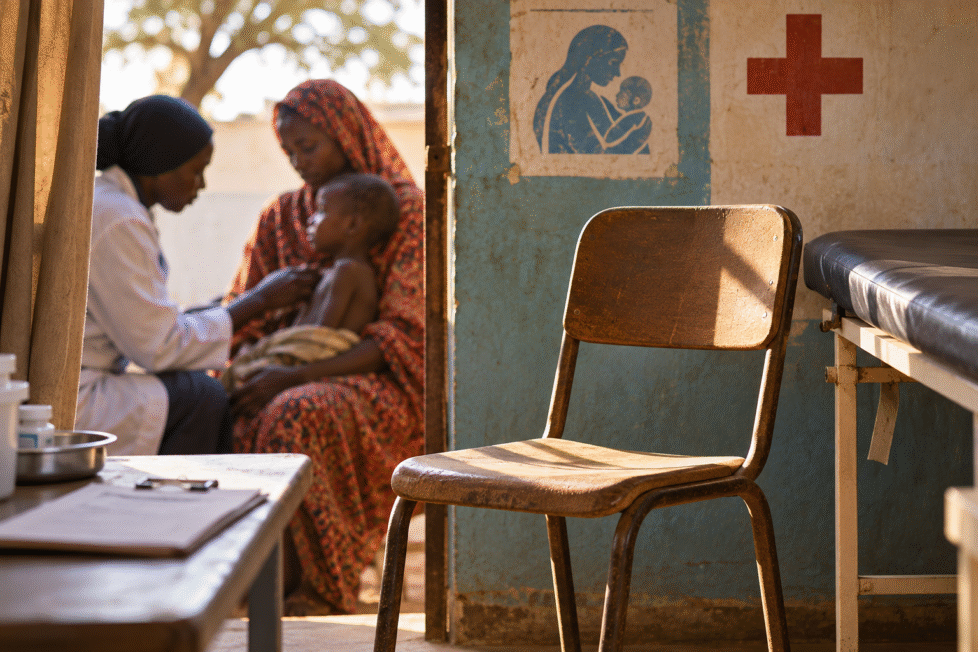

There is a chair in almost every clinic that tells a story even when nobody sits in it. Perhaps it is beside the examination table, where a mother waits to hear what the nurse will say. Perhaps it stands near the entrance, where an older patient rests after a long journey. We could call it only a piece of furniture. Yet a health facility becomes human through the ordinary acts that happen around such places: listening, explaining, tending, and giving someone the chance to be afraid without being alone.

For many communities in Sudan, the question is whether a functioning clinic and the people who provide care will be there at all. In an alert published on 12 October 2026, the World Health Organization described the combined effects of food insecurity, malnutrition, displacement and a severely weakened health system. According to WHO, 37 percent of Sudan’s health facilities had stopped functioning by 2026. Between January and August, support to operational nutrition stabilization centres helped treat more than 26,000 children with severe acute malnutrition and medical complications.

These figures should not be folded into a single dramatic image. The number of closed health facilities says something about lost capacity. The number of children treated says something about the difficult work still being done. Neither figure tells the complete story of an individual mother, a nurse or a child. Each is a reason to attend more carefully to those individuals.

I have not entered a Sudanese stabilization centre or spoken to a clinician working in one. I write from Fort Collins, Colorado, and would not pretend to carry firsthand knowledge of conditions in Khartoum, Kordofan or Darfur. Sudanese medical workers and families have their own voices, and those voices deserve to be heard before the opinions of outsiders. My contribution is an ethical reflection rooted in Christian faith, not a report from the field.

The empty chair becomes a way of asking what care actually requires. A clinician may know how to diagnose an illness but lack the necessary supplies. A mother may understand that her child needs treatment but be unable to make a safe journey. A hospital may exist on a map while being inaccessible in practice. We learn little from telling such people to be resilient. Their courage does not create medicine, fuel or safe roads.

In the Gospel of Mark, friends bring a man who cannot walk to Jesus. When a crowd prevents them from reaching him, they find an unexpected way to make space. The story has spiritual meanings that extend beyond any modern clinic, and I do not use it to promise miraculous cures. What stays with me is the determination of the friends to refuse a simple answer: there is no room, so nothing can be done.

Such determination belongs to many health workers who continue to serve in terrible circumstances. But no medical professional should be required to become a hero every day to compensate for missing supplies and unsafe conditions. Praise can become another demand placed on exhausted people. The proper response to their work is to strengthen the systems they depend upon and protect them from harm.

Malnutrition changes the character of illness. A child without sufficient nourishment may be more vulnerable when infection arrives; treatment becomes more complex, and recovery can be fragile. WHO reported that cholera and measles pose particularly serious risks to malnourished populations. Prevention, safe water, nutrition services and clinical treatment are therefore not separate luxuries that can be ranked according to how compelling they look in a photograph. They depend on one another.

The same is true of dignity. A parent should be able to ask questions without being blamed for circumstances beyond the family’s control. A child should not have to become a public symbol of suffering in order to receive care. A health worker should not have to surrender personal safety or professional judgment to satisfy someone else’s demand for a reassuring story.

Some observers are tempted to describe crises as distant tragedies beyond the reach of moral responsibility. In the parable of the Good Samaritan, Jesus gives a more demanding picture. The stranger on the road cannot be turned into an abstraction; another person notices the injury and undertakes practical care. The lesson does not replace public-health expertise or humanitarian access. It challenges believers to take the advice of that expertise seriously and to reject indifference.

The responsibility is wider than individual acts of charity. According to WHO, attacks on healthcare since April 2023 have caused deaths and injuries, while prolonged insecurity has weakened the delivery of basic services. Protecting health personnel, patients, facilities and routes used to reach care must remain a public priority. Those who cause civilian harm should be held accountable. A call for peace that avoids this demand risks becoming a request that victims quietly endure what is happening to them.

Communities of faith can give support through trusted local organisations, public-health information and compassionate attention to families without seeking religious conformity in return. Sudan includes people of different faiths and backgrounds. Medical care is not a prize for agreeing with a helper. It is a practical expression of the human worth already present in every patient.

A family’s return to a clinic after a long and uncertain journey is not a victory if the required treatment is unavailable. Nor is it a failure of that family. It is a reminder that a place called a health facility only fulfils its promise when trained people, essential medicines, water, safety and the ability to follow up are present together.

Much writing about war is concerned with borders, military developments and negotiating rooms. These matters are important and can determine whether violence will end. Yet a mother’s question inside a clinic is equally urgent: will my child receive the care needed today? A serious vision of peace must be able to answer both kinds of question.

I pray for Sudan’s children and families, for the medical workers who continue to serve, and for those whose care has been interrupted by conflict. I pray for safe access, adequate supplies and the protection of people who make ordinary healing possible. I also pray that those far away will listen carefully and resist turning these lives into occasions for easy moral display.

The empty chair in the clinic is not a metaphor that should make us comfortable. It waits for a person whose name matters, whose fear is real, and whose life cannot be reduced to the number in a report. Peace will become visible in Sudan not only when weapons fall silent, but when someone can sit in that chair, receive honest attention, and return home with a reason to hope.

Documentary source: World Health Organization, “IPC Sudan Food Insecurity and Malnutrition Alert,” 12 October 2026. https://www.who.int/news/item/12-10-2026-ipc-sudan-food-insecurity-and-malnutrition-alert

Sign up to receive the most diverting fiction, essays, analyses and news across Africa in your inbox, on Monday every week.

We don’t spam! Read our privacy policy for more info.

Check your inbox or spam folder to confirm your subscription.