Necessary Non-Fiction: A Reflection On Precursor By Omondi Ochuka
Precursor is, at its most honest, fidelity to what it means to live within the confines and edges of life and death and still commit to living truly and doing it well.


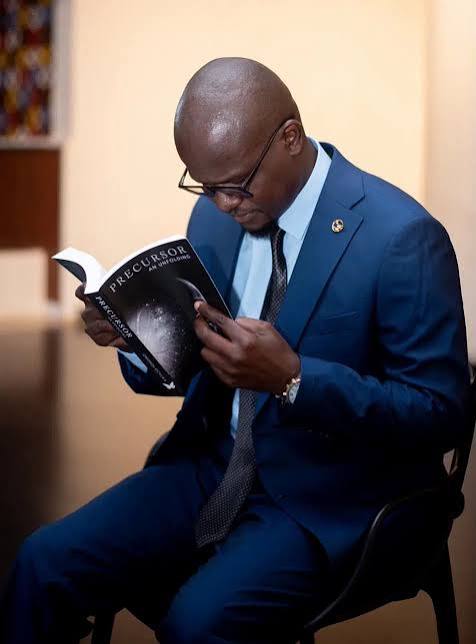


Precursor is, at its most honest, fidelity to what it means to live within the confines and edges of life and death and still commit to living truly and doing it well.
Omondi Ochuka says that when he wrote Precursor: An Unfolding, he wanted it to bleed. I start here because how he languages illness and narrativizes life experiences is essential to understanding Precursor.
Omondi Ochuka was diagnosed with cancer at 19. He has faced grief, pain and insurmountable odds, the magnitudes of which are impossible to comprehend. Nothing encapsulates the magnitude of his affliction, and so, Precursor, I found, exists in the complexity of acknowledging that no words might wholly capture such an experience, and language is but merely a brush painting a picture of his existence. And he is both the painter and the painting, looking into his own face, trying to capture the unseen.
Upon diagnosis, Ochuka was handed a three year life sentence. His only question for the doctor, at the time, was if he could still write. The necessity of writing was his only defense in the face of a cancer that threatened his aliveness.
Precursor is a question. It is also an answer to this fundamental question. Precursor is, at its most honest, fidelity to what it means to live within the confines and edges of life and death and still commit to living truly and doing it well.
The book’s title carries a wealth of meaning: the precarity of a Precursor placed against the provision of An Unfolding, both of which serve as a call to our examining and enriching of our experience of life. The awareness of life’s inherent nature, Ochuka writes, “might compel us to confront the very nature of our mortality, pushing us to question the assumed trajectory of life.”
Ochuka’s excavation of what it means to be truly alive while trapped in long term chronic illness is a gentle one. He paints introspection and self-reflection as gifts that (can) aid in deepening aliveness.
Long term illness, as a personal journey, continually rejects linearity, a stark contrast to expectations often imposed on illness and healing.
Precursor brought notice to the fact that Ochuka’s experiences during the years of writing the book mirrored the current landscape of his life navigating treatment for acute myeloid leukemia (AML), bringing a sharp focus to the cyclicality of life. “I was just finding my way”, he writes, “dreams finally taking shape, when this invisible invader attacked once again. The future I had carefully constructed now lies in ruins, and I must rebuild from the ashes.”
Life, inherently, is a series of constant returns, the particulars of which depend entirely on how the wheels of one’s life turn. Our aliveness, I know mine has been, is constantly bringing us back to the same things in different shapes and forms, and the cyclicality is dependent almost entirely on our willingness to examine our lives deeply and truly. Ochuka’s life is one where courage has been pitted against a life calling to fear and resignation, time and again. Precursor examines the different shapes and forms of the cyclicality.
It is the repetitive nature of coming to something, be it a better relationship with self or the rough weathers of life. One keeps returning to gratitude, to presence, to the acknowledgement of the different demands of life. It is not enough to know, one has to cultivate their reality, relentlessly. One has to sit with self, make a home with self. Whatever life takes, one must stay with it, hold onto its complexities.
At every turn of the page, I felt as though Ochuka was inviting me into rooms in his life, to see the ways he had learnt to choose courage over and over again. It was an act of literary intimacy: how a writer invites you into their life and trusts you to hold their work as a thing that is also within yourself.
“Returns to life especially in the texture of struggle, or grief,” he writes, “don’t cushion from subsequent returns to them. This might be the hardest truth about being a person. You’ll face the same struggles over and over, in slightly different shapes, and each time it will feel both familiar and devastating. No amount of previous survival guarantees future survival. You just keep doing it.”
Ochuka excavates survivorship in the light of honest survival. He is resistant to the principle of assigning heroism and bravery arches to survivors. He continually beckons for acknowledging, examining and accounting for the circumstances and cost of survivorship.
In delving into survivor’s remorse, both divides of it — gratitude that spurs intentionality in living and immense grief that alters the survivor’s relationship with illness, the world around them and people adjacent to those griefs — I inherited a new perspective that nudged on my perceptions and further appreciation for the grace with which Ochuka carries himself and others.
Reframing survival in this manner served as a call to look at the manner in which we have conversations about illness. Plenty of times conversations about illness often gravitate to a spectacle of inspiration porn or a dismissal of the individual existing in the confines of illness.
Ochuka poses the question of whether the sick individual is to be defined solely by their affliction or whether they retain different aspects of being a person? He calls for a recalibration of the lens through which we perceive healing and wellness.
Drawing from my experience living with chronic mental illness and my expertise as a mental health professional, I know this reframing is necessary.
He writes: the sick “are individuals with unique stories, with dreams yet to be realized, and with an ongoing experience.”
Various aspects of life can and do continue in spite of the illness. Relationships exist even in the context of prolonged illness, in spite of the complexities of desire and difficulties of maintaining healthy relationships amidst the immense darkness of chronic illness.
Precursor illuminates Ochuka as he returns to his dreams, dreams of academic excellence, that he continues to pursue and achieve even as cancer ravages many aspects of his life.
I am proud and joyful at his victories.
He honours fatherhood in the texture of illness, conversations with his daughter about the same and the manner her existence has marked and textured this journey differently, fathering even with sufficient distance between them with a devotion that is beautiful and sobering. The manner in which he loves his daughter awes me endlessly, and continually challenges me to be a better parent.
He is an artist through and through. His writing methodical to a fault, even when Precursor clearly deviates from the chronological telling of events that is typical in most memoirs and autobiographies. His storytelling is enriched with music, poetry and philosophical anecdotes that texture his life experiences. I would listen to his music albums in intermissions and they enriched my reading experiences.
Even though Precursor rejects the conventional chronological telling of events, it singles out and cements particular threads in his life. No thread is, perhaps, as dominant as that of his grandmother and her influence on him, a childhood both cherished and reaching for meaning.
I am appreciative of the manner in which he sees and paints people beautiful. His story told in the register of people in turn makes it carry so much depth.
Dana, his grandmother, his very heart and soul who is grace personified and endlessly stern on her love and philosophies.
His being is mirrored in the register of his grandfather from whom his meticulousness and susceptibilities to attention. He is the source of Ochuka’s quietude and the fuel behind his continued pursuit of academic excellence.
His uncle whose grief runs deep not only because of the gap his loss left in the family, but all the ways Ochuka learnt to read his being through Freddie’s eyes.
Dr Awiti who implored him to stay with the pursuit of his degree even with multiple complications and frustrations. Friends who have believed in him and stayed, companioning him on his journeys.
He writes even of villagers, Apas and Pele. All stories matter, and the people that companion us are just as integral to our journeys as the meaning we assign to each.
“Mama tells me we simplify the things we don’t understand by giving them names. Like a combination of letters could ever explain our existence.”
Precursor is a search formeaning, an existential inquiry that has persisted long before illness necessitated more introspection and self-reflection. I continue to relate to this, being that I am much the same way, I cannot seem to walk far enough from the inclines to existential questioning.
What if suffering does not have a reason and it just is?
What then if all suffering is meaningless?
Is being born the greatest injury a human being will ever be subject to?
What does it mean for our aliveness if it’s its very own precarity?
Precursor is rich in metaphor, used as a lens to image the experience of life.
I was incredibly curious when I saw the book cover for the first time, and in an attempt to assign meaning to things, I have made connections between the imagery on the cover and the MRI scans referenced in the book. But what about the other image: the butterfly? In the cover, half of his face is in the light, the other half is invisible in the embrace of a butterfly’s wings. It is like a painting of an individual who has alchemized his wounding into light (for himself and others), and where he fails to honors it and persists in being true to form. An utterly honest faithfulness to the existence of light and darkness, being and becoming, the credence of undoing and unfolding without one taking precedence over the other.
Ochuka acknowledges that he has used poetry and metaphors to conceal the weight of living with cancer and the implications of illness marring every aspect of his life. I suspect these also operate as a cushion in the wake of the violence of treatment. He writes about flowers cracking open through concrete to reveal sea depth.
Life will, sometimes, have its way with us: what do we do then?
He reframes decay as revealing substance, it does not take away from the happenance of it, or the violence inflicted on a life in the face of adversity, just that we persist even in the face of indomitable odds, sometimes because we must.
Precursor, as should be obvious now, is at its heart a conversation about cancer, even if sometimes the conversation is too broad that even multiple framing is not enough to exhaust. Yet Ochuka succeeds, through his experiences, to educate us on cancer diagnosis and its implications; cancer treatment, management, and other health-seeking behaviors; the multitudes of narratives assigned to living with cancer; and all the efforts being made to broaden our collective awareness.
He does all this while steeped in self-reflection and constant recalibration of his life’s purpose as a cancer survivor. True testament to his commitment to reinvention, he continues to harness his lived experiences as a survivor to curate conversations around cancer, and has become a resourceful wellness activist and advocate, alongside his work as a health economist and researcher.
Cancer, he has made us understand, is also a subject of systems and cultural/systemic conditionings. He says that even as we “confront the uncomfortable truth that cancer, in its physical manifestation, is but a symptom of a deeper malady — the cancerous state of our own existence” and “embark on a transformative journey towards healing and well-being”, we must not forget that the cancer conversation demands political courage.
It is not enough to only advocate for infrastructure to combat cancer, but we must also center personalized patient centered approach to care, that moves beyond just treatment to encompass healing and wellness. We must collectively reflect on systemic issues that amplify illness and its experience thereof, that which, upon honest inquiry, might spur collective action, not just in healthcare but in other areas integral to wellness.
It is this detour that creates a hybrid between personal cancer journeys and the systemic environments where all these occur that makes Ochuka opine that “what I’m writing, is Necessary Nonfiction. It doesn’t flinch, beautify or lie to make living easier. Things hurt for real. Fear has teeth. Survival is not metaphor but an invoice with no guarantee of receipt. Necessary Nonfiction is what we write because we are still here and that fact alone demands documentation.”
Necessary Nonfiction, surprisingly, gives definition to my own work.
I’ve always been creative. Before I was diagnosed with Depression and Generalized Anxiety Disorder, I was writing, almost always, everywhere. Then with mental illness came the inability to write, it wasn’t even that I couldn’t write, my pain was too much. It was already bad enough that I was fighting every day to stay alive with a mind trying to kill me; I couldn’t even begin to read my pain, looking at my pain, the internal turmoil I was going through every day was damaging enough, impossible.
When I came upon Omondi Ochuka’s work, a lot of it startled me. I felt a kinship to him, in the sense of admiration and honour that he somehow has managed to write down pain the magnitudes of which few can grasp.
There are experiences far beyond the reaches of language, that even when one finds the words to express what it means to have lived with cancer for as long as he has, faced with griefs that border drowning and odds as insurmountable as his, a lot of it remains inexpressible. The courage, perhaps, is trying anyway, reaching into the deepest recesses of language to bring meaning to light.
Ochuka’s friend Seise Babgo wrote weeks prior to the book launch: “I hope we are deserving of all the things he offers. That we can sit in its complexity and light.”
I am deserving of the honour of the gift that is Precursor: An Unfolding.
You will, too.