The Wüstenschiff: Johann Christoph Bischoff’s 1932 “Ship of the Desert”
The Wüstenschiff, or “Desert Ship,” was a 1920s German engineering proposal – a land-borne ocean liner designed to ferry passengers and cargo across vast deserts.
 by
by 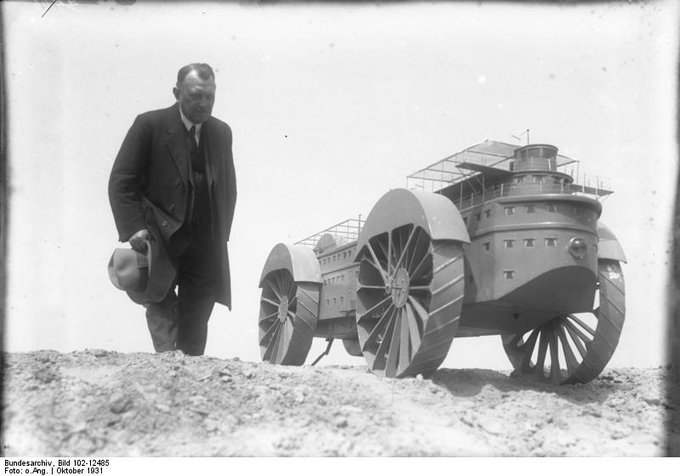


The Wüstenschiff, or “Desert Ship,” was a 1920s German engineering proposal – a land-borne ocean liner designed to ferry passengers and cargo across vast deserts.
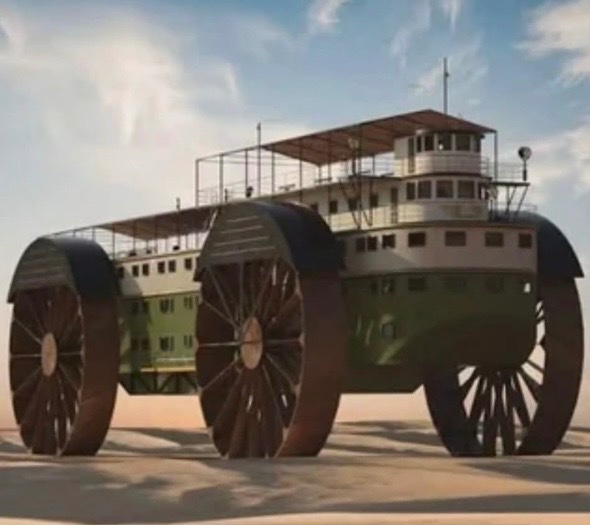
by The Wüstenschiff, or “Desert Ship,” was a 1920s German engineering proposal – a land-borne ocean liner designed to ferry passengers and cargo across vast deserts. Conceived by engineer Johann Christoph Bischoff, named in some sources as Johann Christian Bischoff, the ship would have been 40 m long and 13.5 m high, carrying 150–300 people, with two 450-hp diesel engines and enormous wheels (12–15 m in diameter). Though Bischoff built only a small scale model, the idea lives on in retrofuturist lore.
Origins and Invention
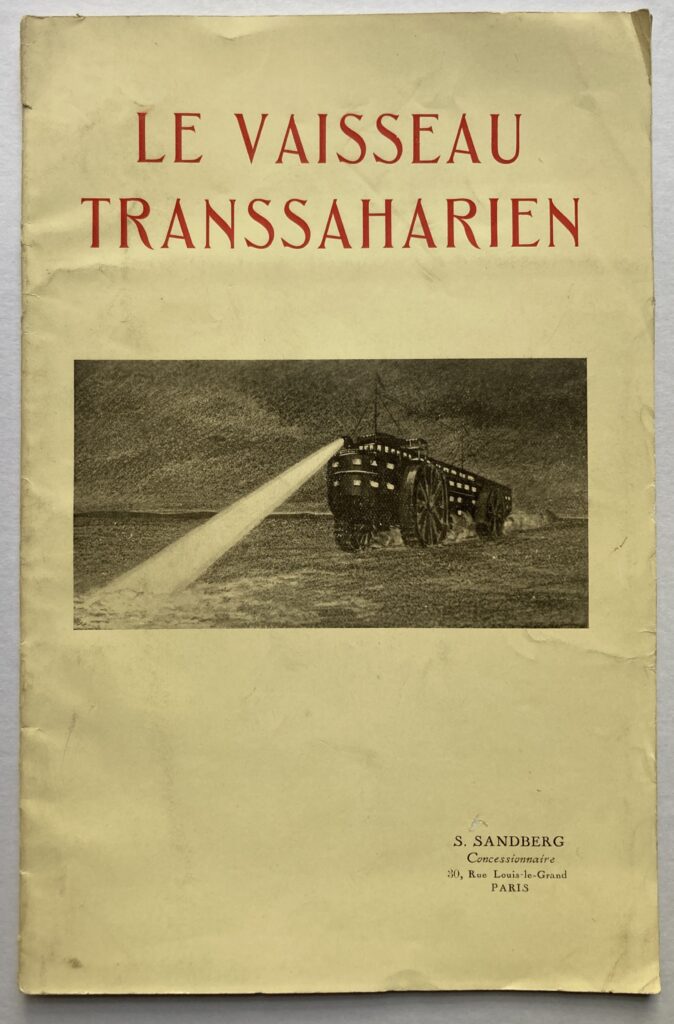
In the mid-1920s, a German inventor named Bischoff announced an audacious plan to traverse deserts by road-free means. Bischoff’s vision was outlined in a 1927 prospectus published in Paris by S. Sandberg (as Le Vaisseau Transsaharien). The cover of this pamphlet – a fanciful “science-fiction” drawing – advertised a massive liner-on-wheels for the Sahara and beyond.
An accompanying German report (Bibliothek der Unterhaltung und des Wissens, 1927) lauded the invention as patent-pending “in all colonial powers,” intended for both passenger transport and freight across uninhabited deserts. In that article, Bischoff is described simply as a “German engineer” from Kiel, emphasizing the project’s German industrial backing.
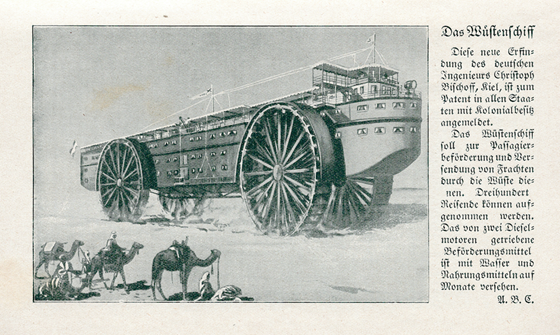
Bischoff’s timing was telling. In the 1920s Germany had lost many colonies after World War I, but colonial ambitions still pervaded engineering fantasies. The prospectus explicitly argued the Wüstenschiff would “counter the expense and difficulty of constructing roads or railways” across deserts like the Sahara. Framed as a collective transport solution for arid frontiers, the idea had both economic and military overtones. Indeed, one observer noted it was conceived “during a period of German rearmament”, reflecting how futuristic gimmicks often intersected with interwar militarism.
Design and Specifications
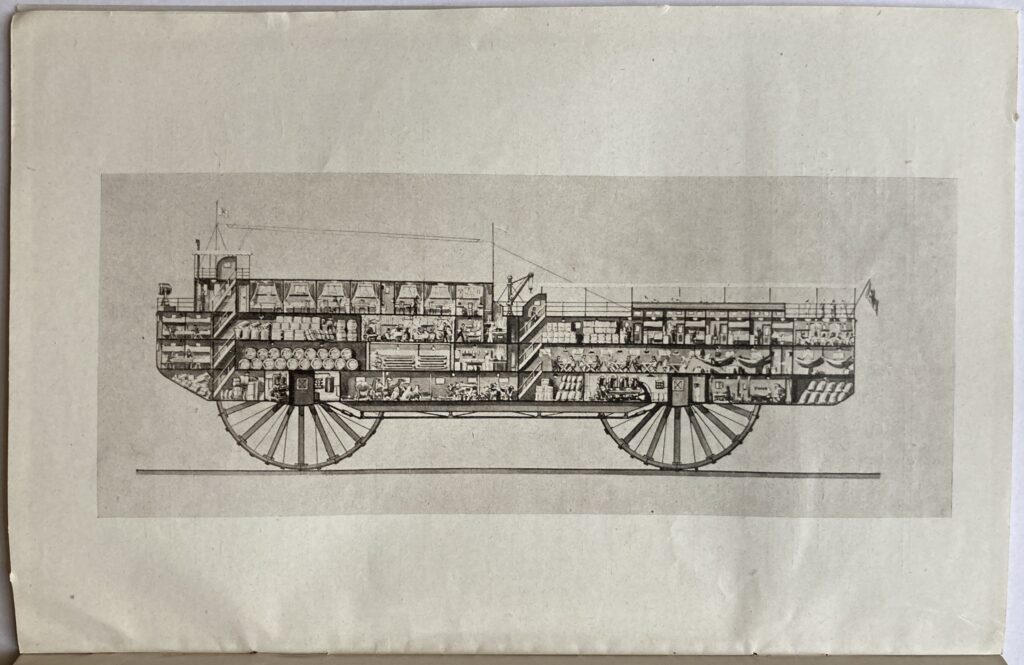
According to Bischoff’s prospectus, the ship’s dimensions would be about 40 meters long, 8 m wide at the bow, and 13.50 meters tall (to the upper deck), with a passenger capacity of between 150 and 300 passengers. The interior was to include lounges and dining salons akin to a cruise ship, plus accommodations for a sizable crew and even a doctor. The spec sheet enumerated the crew as one driver plus assistants, mechanics, cooks, stewards, etc, reflecting a vessel more than a vehicle.
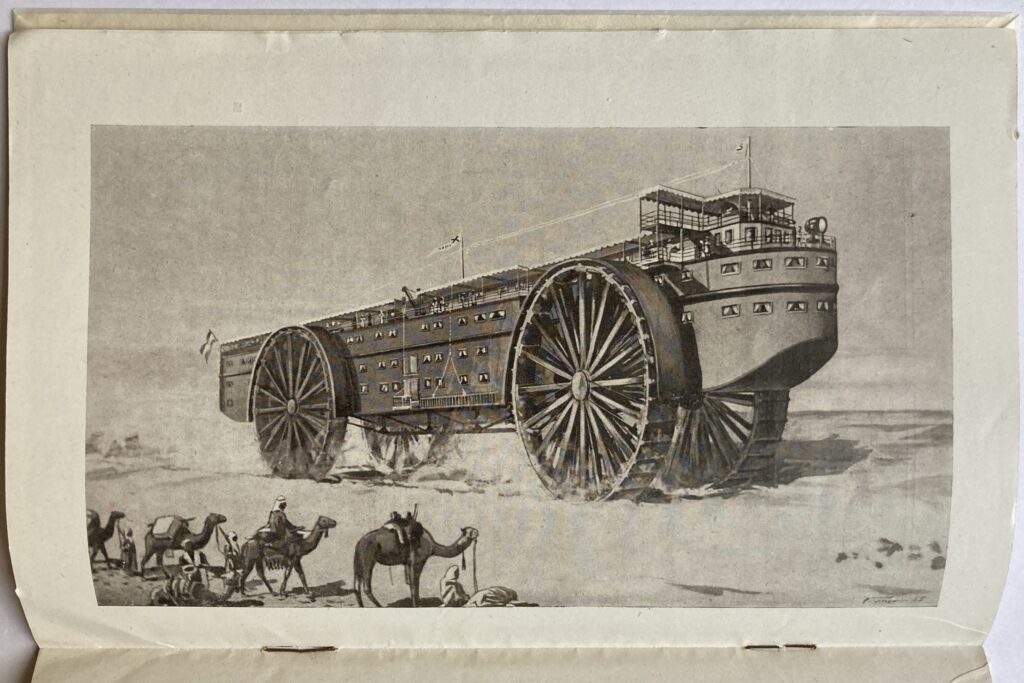
The wheels, from the prospectus drawings, were six spoked wheels nearly as tall as the hull. The vocabulary emphasized that the wheels would be “unbereifte Räder”, meaning wheels without tires. Without air cushions or tracks, such massive iron wheels would have spread the weight. Bischoff’s own material notes claim provisions of water and supplies for months, implying the vehicle weighed many tons. The ship was to be driven by diesel engines of 450 horsepower, roughly comparable to small marine diesels of the era.
Engineering Feasibility
Given the outlandish dimensions, engineers have long doubted the Wüstenschiff’s practicality. Even in its own time, commentators would have noticed several red flags.
First, a 60 to 900-ton vehicle on only four or six wheels would have enormous weight per square centimeter on sandy soil. By the late 1920s, caterpillar tracks had already been adopted for tractors to solve exactly that problem; Bischoff’s choice of fixed wheels seems almost retrograde. One German model-builder noted dryly that a multi-hundred-ton wheeled chassis would promptly “sink into the sand”.
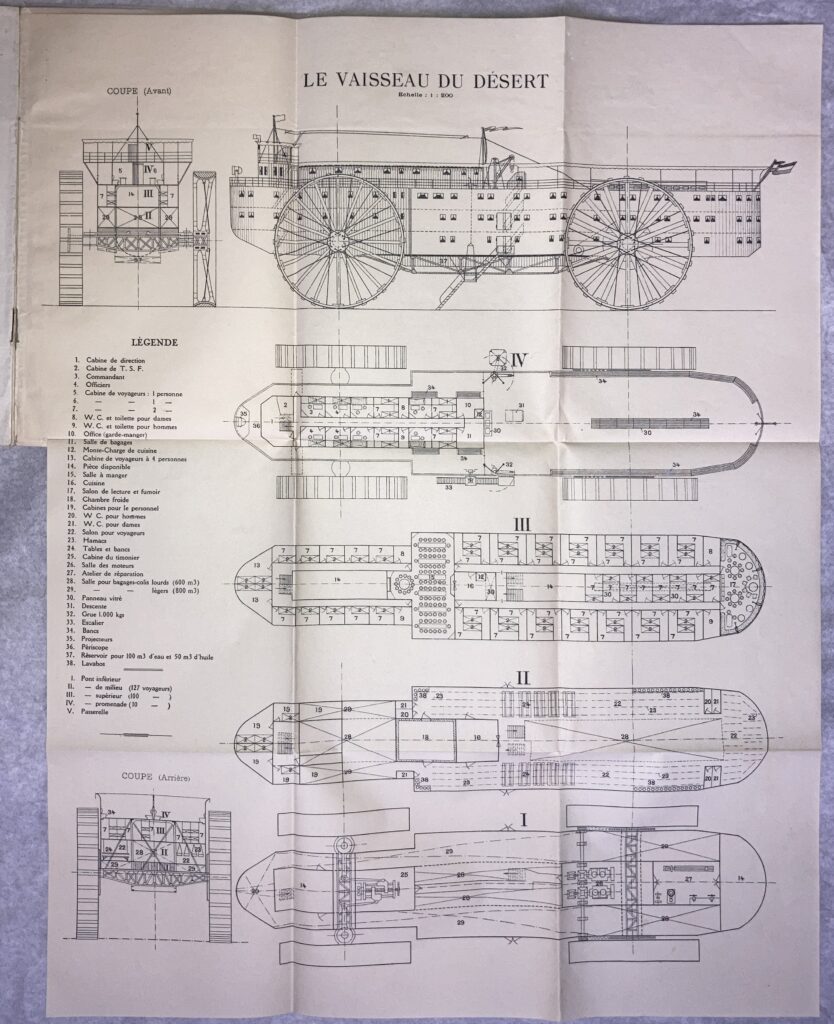
Second, steering such a behemoth would be non-trivial. The design had no built-in steering and many have wondered how it would turn. Bischoff’s pamphlet only mentioned a rudimentary telegraph between driver and engineer, but omitted details like steering mechanisms or suspension.
Third, the power: even with 450–900 hp, moving that mass at anything more than a crawl through dunes would strain the engines. Perhaps a nuclear reactor, which came later, would have been more suitable. However, at the time, diesel tech was already advanced. German U-boats used large diesels, but scaling them to road-going machinery of this scale pushes mechanical limits of the 1920s.
No trials or full-size trials were reported. According to the Gerald Cloud Rare Books description, “although it was not fully realized, a photograph from 1932 confirms that Bischoff did construct a scale model”.
Cultural and Artistic Context
Bischoff’s Wüstenschiff sits squarely at the crossroads of 1920s futurism, colonial imagination, and publicity stunt. The design evokes the period’s taste for grand transportation schemes – think dirigibles, hovercrafts and other “ships of the land.” Indeed, Cloud notes the Wüstenschiff is “reminiscent of the dirigibles” Zeppelin had built earlier, projecting the ocean liner metaphor onto land vehicles.
The prospectus cover, with its cruising-liner superstructure and figure-scaled desert backdrop, was almost knowingly fantastical. The blending of adventure fantasy with technical jargon reflected an era when technological optimism flirted with utopia.
The Sahara itself loomed large in European imaginations during this era. Bischoff’s imaginations satisfied notions of “conquering” or “opening” the desert. Colonial powers of the time faced the high cost of desert railroads or motor roads. French and Italian colonial offices experimented with rail or truck convoys in North Africa, but nothing like Bischoff’s vision. In literature and comics of the early 20th century (e.g. Hugo Pratt’s Corto Maltese, though later), the image of a massive dune-truck looms as a symbol of hubris and futurism. Bischoff’s Wüstenschiff fits into that retro-futurist vein.
Reception and Legacy
In its own time, the Wüstenschiff appears to have made a brief media splash but did not advance beyond concept. Bischoff’s model may have been shown to potential investors or at a trade fair, but aside from the 1932 photo there is no record of public demonstration or press coverage following that year. The idea quickly faded – overshadowed by more practical desert vehicles and the looming Great Depression.
Today, the Wüstenschiff remains a curious footnote in the history of technology: a grandiose desert liner that never left the drawing board. While Bischoff’s patent filings and publicity materials show genuine effort, the project likely ran out of steam, literally, when confronted with the realities and limits of engineering in the early 20th century.