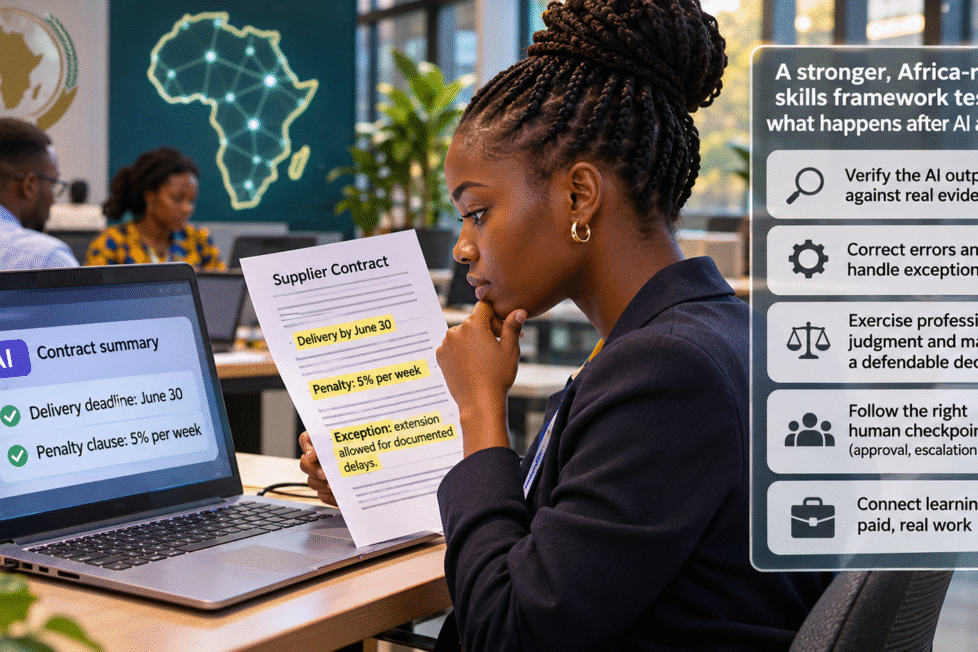

Suppose a young employee asks an AI system to summarize a supplier contract. The response arrives in seconds. It sounds assured. It even identifies a delivery deadline and a penalty clause. But the employee who needs to act on that summary has a more important job: open the original contract, find the relevant language, and decide whether the machine has mistaken an exception for the rule. A qualification that tests only the ability to produce the summary misses the part of the work that matters most.

That is the practical challenge facing Africa’s newest education commitments. At a November 6 meeting in Addis Ababa, ministers from African Union member states endorsed implementation plans for continental education and technical and vocational training strategies. They also adopted an African Continental Qualifications Framework, designed to make qualifications more transparent and comparable across countries. The same meeting advanced digital education indicators and work on responsible AI. Those decisions deserve attention, because a qualification can become much more valuable when employers know what its holder can actually do.

There is a trap here. If educators respond to AI by adding a generic prompt-writing module to an existing course, students may earn a new certificate without developing the judgment needed for the next job. A polished answer is easy to display at a graduation ceremony. An employee’s ability to detect a false statement, challenge an unfair recommendation, or recover from a failed automated workflow is harder to demonstrate. That is precisely why it should count.

Africa has reason to approach this question from its own economic circumstances. The United Nations Development Programme’s October analysis argues that the gains from AI will depend on who can access technology, skills, finance, data and social protection, and on whether local firms can participate in the value being created. That argument should change what governments demand from education providers. More training seats alone cannot tell us whether a worker can perform a task accurately, whether the firm gains productivity, or whether a young person gets a durable opportunity to learn.

The first reform should be a two-stage assessment. Give learners a realistic work problem, access to appropriate AI tools, and the evidence they need to evaluate the result. Then ask them to explain where the tool could be wrong, identify which claims they verified, and make a decision they can defend. The final mark should reflect the quality of their reasoning and correction, not the fluency of the output.

Consider an insurance trainee evaluating a claim, an agricultural extension trainee preparing advice for a farmer, or a local-government clerk checking information for a resident. These are examples of possible assessments, not accounts of specific programs. In each case, the trainee must discover when a seemingly helpful response rests on an outdated document, incomplete facts or the wrong policy. Good assessment would make those mistakes visible before a real citizen, farmer or policyholder bears the cost.

The second reform should concern ownership. A student who can generate a draft but cannot explain who approves it, who corrects it, or how a mistake is reported has learned half a workflow. Universities, technical colleges and employers should jointly set standards for the human checkpoints in AI-supported work. In a qualification exam, the learner should know when to stop the tool, consult a supervisor and preserve a record of what happened. These skills belong in accounting, engineering, health administration and public services, not only in computer science.

Employers must carry part of the burden. They cannot complain that graduates lack experience while removing every entry-level assignment that teaches experience. When AI handles the first draft of a report or the first pass at a customer request, a junior worker still needs an opportunity to compare the draft with reality. Firms can create supervised rotations in which young employees check evidence, correct errors and gradually take responsibility for harder cases. The goal is a visible progression from observing decisions to making defensible decisions.

Public purchasing can reinforce that progression. If a government funds an AI training partnership, it can ask for evidence of what participants do six months later: which tasks they perform, which errors they can detect, whether employers assign them more complex work, and how many gain paid responsibilities. A certificate count remains useful administrative information, but it does not establish economic value. Programs should report what actually changes for trainees and their employers, with measurement suitable for local conditions rather than one imported global scoreboard.

The International Labour Organization’s account of Africa Skills Week, held in Harare in October, stressed stronger links among training, employment and industrial development. This is the right direction. The continent needs to connect formal qualifications with practical evidence from workplaces. A common qualifications framework could help countries recognize those skills across borders. But comparability will mean little if the assessment behind the certificate rewards performance that a machine can imitate on demand.

A third reform should widen access to the opportunity to prove competence. Students at well-funded campuses may have stable connections, advanced AI accounts and sophisticated simulations. Learners elsewhere may work with shared devices and intermittent internet. A fair system should evaluate judgment under realistic resource conditions. It should also offer a pathway to demonstrate equivalent competence through supervised workplace projects. Otherwise, a new digital credential could unintentionally reward access to technology more than capability.

The African Union’s broader agenda recognizes the size of this implementation challenge. At an October 30 ministerial discussion on digital transformation, officials placed infrastructure, digital trust, AI and skills among interlocking priorities. That is a useful reminder that no curriculum change can compensate for unreliable electricity or unaffordable connectivity. Yet governments can still design sounder tests now, even while building the infrastructure needed to scale them.

In my work helping organizations adopt AI, I have seen how quickly attention drifts toward the number of people using a tool. The more revealing questions concern the jobs they finish, the mistakes they catch, and the confidence they develop to exercise judgment. A young employee who learns to question a machine’s answer has gained a skill that remains useful even when the software changes. The employee who learns only today’s interface may have to start again with the next release.

Africa’s qualifications decisions create an opening to set a better standard. Make AI-assisted work part of the assessment. Require evidence checks, a clear human decision, and a record of how mistakes are corrected. Then connect that proof to paid work, employer mentoring and recognition across borders. The point of an African qualification should be the capability it certifies, especially when a machine can make a weak answer look finished.

Sign up to receive the most diverting fiction, essays, analyses and news across Africa in your inbox, on Monday every week.

We don’t spam! Read our privacy policy for more info.