
Ethiopia is often remembered as the symbol of African resistance to European colonialism, yet the Ethiopia that became that symbol was far more complicated than the image it came to represent. Menelik II defeated an imperialist European power at Adwa, but the Ethiopian empire was itself expanding through conquest. Haile Selassie became a messianic figure to the Rastafari, yet he rejected his divinity and was also forced into exile after the Italian invasion. Ethiopia, a country that never belonged to the Black Atlantic nevertheless became central to its political and even religious imagination.

So how did Ethiopia become something greater than Ethiopia itself?

ACT I — THE VICTORY

The symbol started in 1889 when King Menelik II, later emperor, signed the dubious Treaty of Wuchale to recognize Italy’s claim over Eritrea in exchange for financial assistance and military supplies. A dispute later arose whereby the Italian interpretation of the document, unlike the Amharic interpretation, claimed that Ethiopia was a protectorate of Italy. This allowed Italy to pursue its imperial ambitions in the region, which led to the First Italo-Ethiopian War.

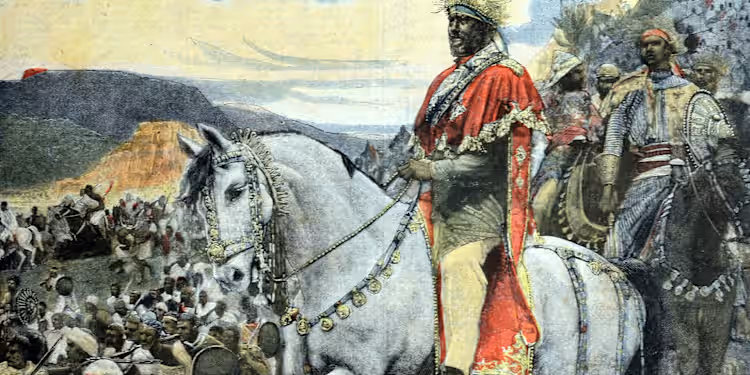
The Battle of Adwa took place in 1896, led by King Menelik II, where Italy suffered a severe defeat by the hands of the Ethiopians that led to the loss of the war and the collapse of Francesco Crispi’s government. The Ethiopian victory at Adwa was certainly not the result of chance, as during the preceding decade, Menelik II had centralized the Ethiopian state and acquired large quantities of European weaponry while mobilizing nobles from across the empire into a unified national army. These reforms happened while Italian forces under General Baratieri carried out poor strategies, such as weak reconnaissance, troop division across difficult mountainous terrain, and underestimation of Ethiopian forces. These factors led to the eventual victory of Ethiopia, which would leave behind a legacy for later generations to adopt.

Yet the symbolism and legacy of Adwa stood in high contrast with the historical realities of Ethiopia. Menelik II’s original intention was not to champion Pan-Africanism, as his interests were in protecting Ethiopian sovereignty; peoples across Africa and the Black Atlantic interpreted this victory entirely differently. To them, this was the first time they had seen an African power decisively defeat a European imperial power. This was far more than simply a military victory, but rather a greater victory that altered the psychological relationship between the colonized and the colonizer and proved that Western imperialism was not invincible.

Curiously, this symbolism also emerged alongside and despite Menelik II practicing his own imperialist ambitions in the region, whereby Ethiopian territory was expanded through the military conquest of the Oromo and other peoples. In other words, the future symbol of African liberation emerged from a state that practiced conquest and empire-building, and thus, the future symbol of African nationalism and anti-colonialism was born from these actions. However, some defenders of Emperor Menelik II, such as Bahru Zewde, have argued that these campaigns were driven by strategic necessity rather than pure imperial ambition, particularly due to the complete European encirclement of Ethiopia, in order to increase manpower and military resources that later proved critical against Italy at Adwa.

Thus, this symbol of African liberation did not emerge because Ethiopia embodied the perfect image of anti-colonial ideals, but rather because colonized and oppressed people desperately needed proof that European domination could be shattered regardless of the realities of Ethiopia. This was the basis and foundation of the idea that completely shadowed Ethiopia and became greater than it. Whether the idea held up with the nuanced political realities of Ethiopia did not matter. What truly mattered was that they witnessed what they thought was the impossible becoming possible.

ACT II — THE IDEA SPREADS

Long before Adwa, Ethiopia already occupied a revered position within Black religious and political beliefs; yet, it was more a symbolic biblical homeland than a political reality. Adwa specifically altered that relationship by giving credibility to this already existing ideal. Adwa was initially an Ethiopian victory that transformed through multiple stages and became a greater idea at each step. First, it was a military victory, then it was a complete Italian defeat, then it spread outside the continent to Black newspapers in the United States, where it was represented as a victory against segregation, and later to Pan-Africanists as a symbol of greater African nationalism.

By the early twentieth century, the victory had entered Black discourse across the Atlantic. Pan-African thinkers such as Marcus Garvey and W.E.B. Du Bois praised Ethiopia and invoked it as evidence that African sovereignty was possible, and, on the other side of the Atlantic, the Afro-Brazilian newspaper “O Menelick,” named after Menelik II, celebrated Black identity and African connection and was written by prominent female writers. These examples suggest that Adwa was no longer an Ethiopian national victory but a victory for Black people beyond Ethiopia.

In Jamaica and other parts of the Black Atlantic, Ethiopia had great significance within Black Christian thought long before the Battle of Adwa, particularly because of passages in the Christian Bible that mention Ethiopia. This, alongside deep inequality within colonial society, made existing ideals like Ethiopianism and the back-to-Africa movement more compelling. Ethiopianism already viewed Ethiopia as a symbolic homeland, while the back-to-Africa movement had some initial success with the creation of the nation of Liberia. Adwa transformed these ideals from mere abstract aspirations into a living and tangible political reality, which later proved to be a catalyst for the Rastafari movement that began with the coronation of a Black king.

ACT III — THE EMPEROR BECOMES A MESSIAH

In 1930, Emperor Tafari Makonnen was crowned and assumed his baptismal name, Haile Selassie, meaning “Power of the Trinity,” while also holding the titles “Conquering Lion of the Tribe of Judah,” “King of Kings,” “Lord of Lords” and “Elect of God.” Verses like Revelation 19:16 — “And he has a name written on his robe and on his thigh: KING OF KINGS AND LORD OF LORDS” — were interpreted alongside his imperial titles. This, paired with the claim in Article 3 of the 1931 Ethiopian Constitution that Haile Selassie descended from a line tracing back to King Solomon, was key to solidifying Rastafari interpretations of the emperor.

Yet, the remaining puzzle was why Haile Selassie was seen as a Messianic figure within Rastafari interpretation, but not Menelik II, especially when it was he who defeated Italy, and it was Haile Selassie who was defeated?

This was mostly due to media coverage, as there was far more international newspaper, film and radio coverage in Haile Selassie’s time than in Menelik’s. Menelik II laid the foundation for Haile Selassie with the Battle of Adwa, and Haile Selassie was linked to the prestige and reverence that came from it since he was the emperor whom millions of Black people could actually see.

Leonard Howell, alongside other early Rastafari founders and theologians such as Archibald Dunkley and Joseph Hibbert, cited multiple scriptures from the Holy Bible, particularly those in the book of Revelation, and interpreted Emperor Haile Selassie’s coronation as a fulfilment of these prophecies because of his imperial titles. Interpretations by early Rastafari founders also cite Marcus Garvey as a prophet because of his famous quote, “Look to Africa for the crowning of a Black King; he shall be the Redeemer,” though this phrase is disputed because no primary evidence exists proving that Marcus Garvey wrote or uttered those exact words.

Despite being worshipped as messianic figures, Marcus Garvey and Haile Selassie both rejected divinity, and Garvey was notably more critical of the movement and Selassie himself. Yet, Rastafari continued to treat both men as religious figures despite their rejection. Haile Selassie’s rejection was mostly interpreted as humility or a test of faith; whichever interpretation was adopted was not important because, once he fulfilled the prophecy, it far outweighed his own words and became more authoritative than he was.

Garvey’s case was also similar, as it wasn’t important whether he supported Rastafari or not, but rather the fact that he prepared people to imagine Africa, and more specifically Ethiopia, as a source of redemption and as a new Zion.

This suggests that the idea of Ethiopia became of more importance than the actual Ethiopia, as different peoples projected their beliefs and ideology onto it. Neither Selassie, Garvey, nor even Ethiopia itself ever controlled it, and thus it was freed from any single owner. The idea continued to evolve, crossing political and religious boundaries, and so the question is no longer why Ethiopia became this idea but rather what that idea went on to do.

ACT IV — ETHIOPIA BECOMES THE SYMBOL

Adwa had permanently altered the psyche of Africans and led to the realization that Europe was not invincible, thereby expanding the boundaries of what African nationalism considered historically possible. Adwa might not have liberated the continent directly, but it gave birth to the symbol that made the idea of liberation possible. Once this symbol convinced people that independence was possible, nationalist leaders turned the possibility into movements. Figures from future liberation movements across Africa and the Black Atlantic, including Jomo Kenyatta and Amy Ashwood Garvey, formed the International African Service Bureau (IASB), which later helped provide activists with ideas and strategies for the liberation struggles that lay ahead of them.

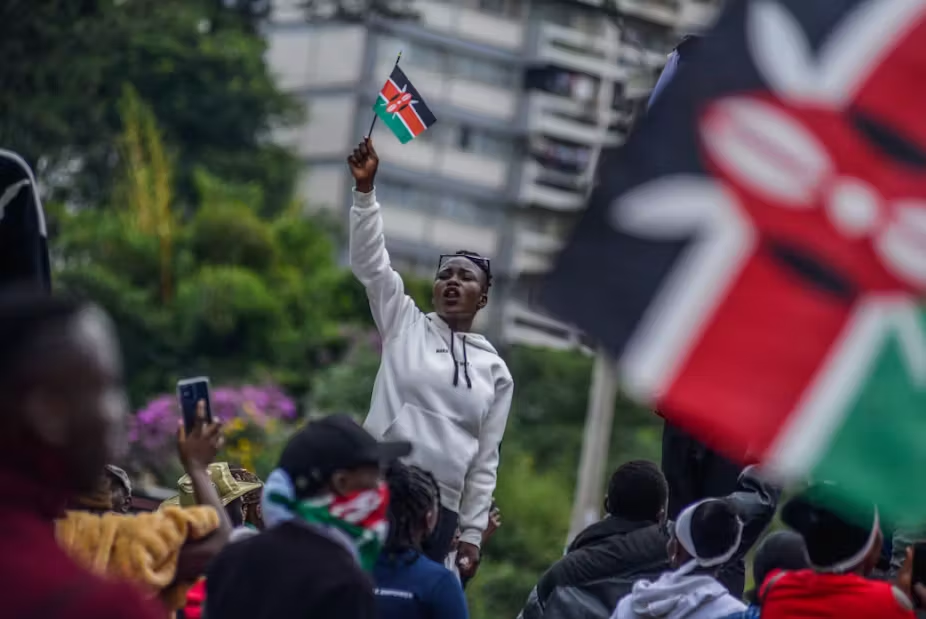
As African states gradually achieved independence, this symbolic authority was transformed into political reality primarily through the creation of the continental Organization of African Unity, now called the African Union, where Addis Ababa was chosen as its headquarters. Ethiopia’s colors were also adopted by newly independent African nations, such as Ghana, Senegal and Cameroon, which demonstrated that Ethiopia’s symbolism had become not only national but continental. By the 1960s, Ethiopia’s influence no longer depended on military victories or emperors, and it had become embedded within the symbols, institutions, and political language of an independent Africa and no longer belonged to Ethiopia alone.

Ethiopia may not have literally been the last bastion of Africa, but to the countless colonized Africans and peoples of the Black Atlantic, it was precisely that.

Sign up to receive the most diverting fiction, essays, analyses and news across Africa in your inbox, on Monday every week.

We don’t spam! Read our privacy policy for more info.