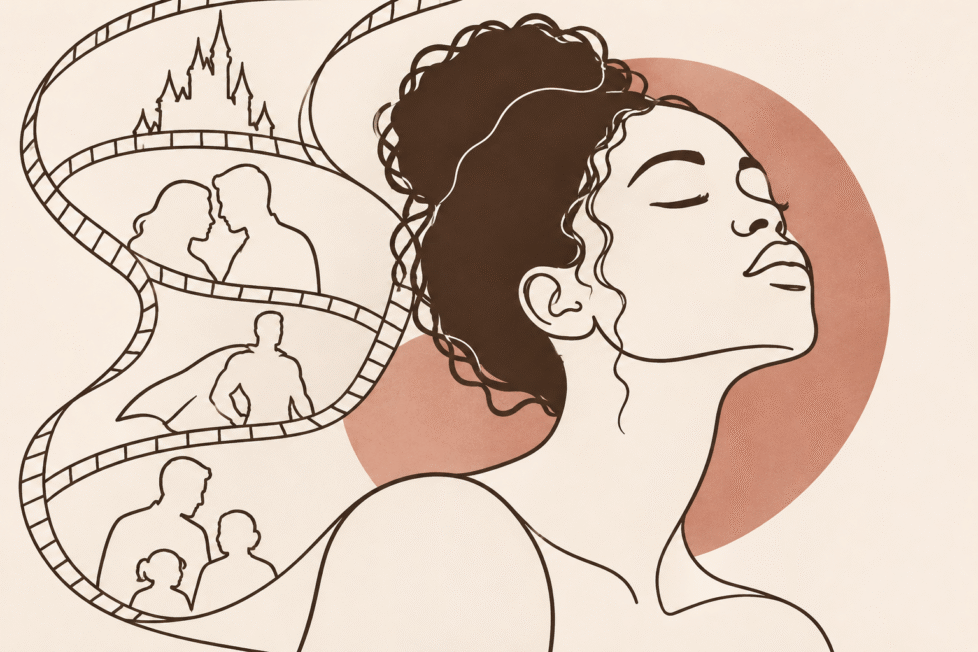

Of course I was brainwashed into thinking white men were superior. I spent my formative years in front of the television, rewinding VCR tapes until they didn’t work anymore.

The Sound of Music was my first film. The charming Captain fell in love with the clumsy, kind-hearted Maria. Kevin Costner scooped Whitney Houston off her feet and into his arms in a crowded room in The Bodyguard. John Smith opened his heart to Pocahontas in Pocahontas. In Three Men and a Baby, I came away thinking white men made excellent fathers. On Walker, Texas Ranger, Chuck Norris continually saved the day. Arnold Schwarzenegger was always saving someone somewhere.

White men were lovers, fathers, heroes and rescuers. They were the men who saved the woman, protected the family and did the right thing.

Black men were rough with women, gangsters, criminals or goofy like Urkel, Will Smith and Martin Lawrence. Roger from Sister, Sister was a joke.

In my early years, I did not observe anything particularly wrong with the Black men around me. Most were working hard, looking after their families and minding their own business. Still, these were not the men I wanted to want. And I’d heard it time and time again: white men were simply kinder, warmer, more romantic, and less violent. I dreamed of myself, an adult woman, in a whirlwind romance with Tom Hanks, the designated good white man of the 90s, promising we would be together forever.

The media I was consuming was conditioning me. I imagined I had long hair and thin lips and tried to imitate the way they spoke on television. White people didn’t do this or white people didn’t do that. I had elevated white people to some godlike standard of how human beings should act.

I hated my skin, not because I wanted to be white, but because I wished I had been born much lighter. I teased my sister for having fuller lips and told her they weren’t pretty. My mother told me thin lips weren’t pretty either, but I wasn’t convinced.

My mother had a complex of her own.

I was disappointed that I wasn’t as light as my mother. She was the most beautiful person I knew, and I was her first daughter, the one who represented her. I felt embarrassed that I didn’t look like her.

Over the years I have dated my fair share of white men from all over the world. It has become a default setting. I’ve spent my twenties and thirties as a princess kissing toads in search of my perfect match. Ironically, even my beloved Disney thought a Black woman’s prize was at least not a Black man, feeding further into the narrative. I imagined I’d eventually meet my own John Smith, my own Kevin Costner or even some rendition of Jesus. No matter what, I was going to make the dream happen.

I thought my way of speaking, my slim body and my knowledge of white culture and media made me the exception and would make it easy for a white man to fall in love with me.

Many white men have liked me. Few have loved me, and even fewer have been genuinely wonderful men. The ones who did were often curious enough about race to name it, but not invested enough to dissect it.

Then there were the others. Men who remarked on how I didn’t have a big bum or a big nose. Men who had somehow been taught that the absence of certain Black features was something worth remarking on.

I met several white men who thought it was in my best interests to teach me something, explain the world to me and rebut my ideas. This despite me being more worldly, educated and experienced than most of them.

From the beginning of time, the patriarchy has taught men that they are better and more capable than women. Gender bias is prominent in any society, but on top of that, you have racial bias sprinkled all over it. I was not simply being spoken down to as a woman. I was also being spoken down to as a Black woman.

I’ve met liars, cheaters, irresponsible men, sad men, racist men, men dependent on narcotics and men with unresolved mental illness. This shattered my dream of perfection, of the white nuclear family that learns an important lesson at the end of every episode, with a laugh track in the background.

Media has changed radically over the past 30 years. There is more positive representation of Black men and Black love. It’s far from where we need it to be. In society, white men still reign as superior, and women as lesser. Nonetheless, growing up has been an adventure. I have learnt that, essentially, people are just people regardless of race. What matters is how someone was raised, what they were taught to believe, and the social conditioning and societal constructs that shape how they see and treat other people.

So what now? Reconditioning and unlearning?

They say I should expand my dating circle. That will increase the odds of being partnered. My ideas of romance have been tarnished, but aside from that, I don’t know how to turn the switch off. I don’t know how to reset. I can rationalise it. I know better. I know the ugly truth. I wish I were ending this article with some profound statement about how my “type” has changed and everything I’ve learnt has eliminated my conditioning. But it is not that sort of ending.

I love myself well enough. I no longer try to brighten my skin or see myself as inferior. At least, I’m certain I don’t. Conversely, I persist in pursuing the dreams of a seven-year-old Black girl who has convinced herself that she is less if she is not chosen by a white man. A living contradiction to some, perhaps. And I see others like me, strong advocates for gender and racial equality, lurking and waiting for this ‘dream’ to materialise, because we have earned it. Because we are special.

You can’t advocate for your own people while simultaneously refusing to be intimate with them. It’s like a curse that I’m carrying around, embarrassing as it is, feeding into the white saviour complex at my own expense. I don’t know otherwise.

Sign up to receive the most diverting fiction, essays, analyses and news across Africa in your inbox, on Monday every week.

We don’t spam! Read our privacy policy for more info.