
Bonface Orucho, bird story agency

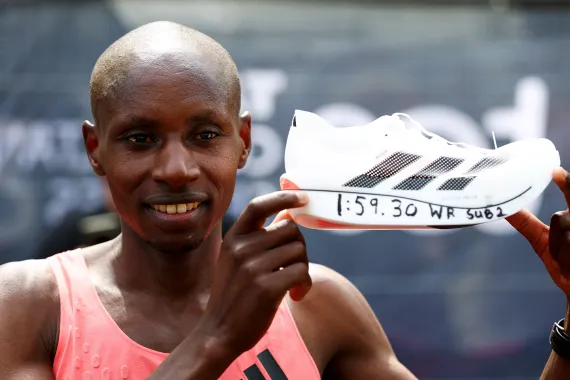
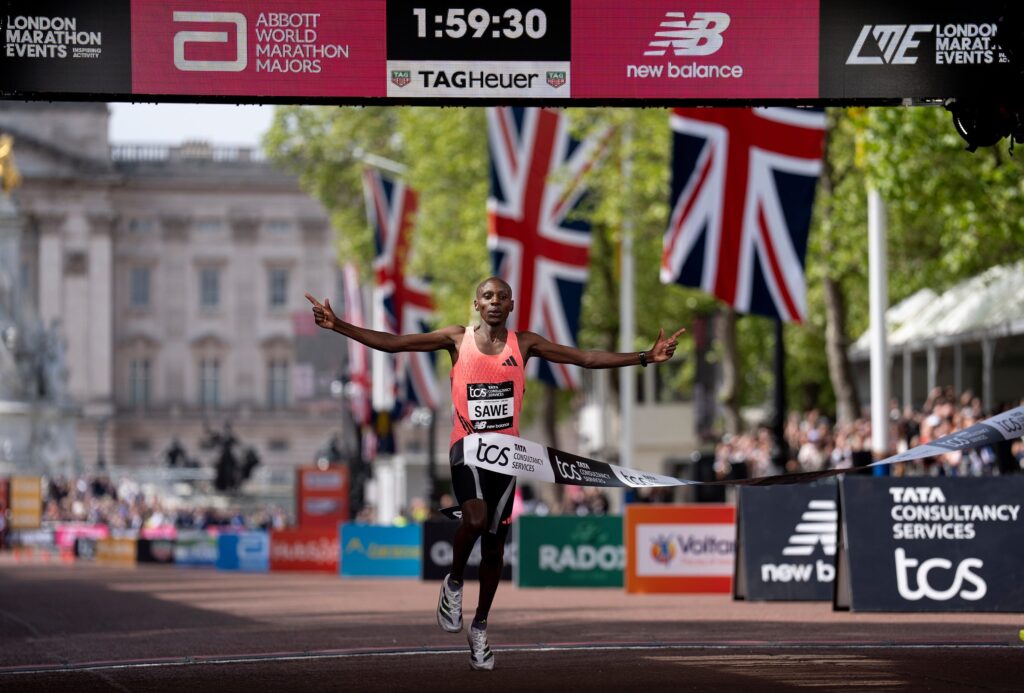
Kenya’s Sabastian Sawe has turned what long sat at the edge of imagination into something concrete, running 1:59:30 at the London Marathon and becoming the first man to break the two-hour barrier in an official race.

For years, that number existed more as a concept than a competitive benchmark. It lived in projections, in lab-like attempts, in conversations about physiology and pacing strategy. What Sawe has done is take that idea out of controlled conditions and place it firmly inside open competition, against a full elite field, on a course that does not typically serve up record-breaking times.

The closest comparison remains when Eliud Kipchoge ran 1:59:40 at the INEOS 1:59 and Challenge, but that performance came with rotating pacemakers and controlled conditions and was not ratified as an official record. Sawe’s run carries a different kind of weight because it counts in the way the sport measures itself.

What makes the London race even more revealing is that Sawe was not alone in pushing that limit. Ethiopia’s Yomif Kejelcha finished in 1:59:41, also under two hours, while Uganda’s Jacob Kiplimo crossed in 2:00:28. All three men came in under what had previously stood as the world record.

That clustering at the top end tells its own story. It suggests that the sub-two-hour performance is not an isolated outlier but part of a broader tightening at the elite level of men’s marathon running. The ceiling did not just break; the entire top layer of the sport appears to be shifting downward.

In practical terms, that changes how races will be run going forward. A pace that once looked unsustainable now becomes a target. Athletes and coaches recalibrate expectations, and race organisers begin to frame elite fields around faster benchmarks. The ripple effect of one performance starts to spread across the calendar.

Zoom out slightly, and the deeper pattern becomes difficult to ignore. The men’s podium in London was made up entirely of East African athletes, Kenya, Ethiopia, and Uganda, a familiar configuration in distance running, but one that now comes with even greater density at the very top.

That same pattern holds in the women’s race. Ethiopia’s Tigst Assefa took the win, continuing her own run at the top of the sport, with Kenya’s Hellen Obiri and Joyciline Jepkosgei completing the podium.

Across both races, the outcome reads less like a set of individual wins and more like a system consistently producing results. Different athletes, same regions, similar outcomes. It is a level of repeatability that points to something more structured than raw talent alone.

Over time, explanations for East Africa’s dominance have ranged from altitude and physiology to culture and early exposure to running. Those factors still matter, but they no longer fully explain what is happening at the very top end of the sport.

What has evolved alongside them is a more organised ecosystem. Training camps are more specialised, coaching is increasingly data-driven, and athlete management has become more sophisticated. Runners are not just emerging, they are being developed within systems that understand how to optimise performance across an entire career.

At the same time, the global marathon circuit has expanded in a way that reinforces this pipeline. Major races in cities like London, Berlin, and Chicago compete for elite fields, offering appearance fees and prize structures that attract the fastest runners. East African athletes, already dominant, are now central to how those races are marketed and structured.

That creates a feedback loop. Stronger fields produce faster races, faster races reset expectations, and those expectations pull the next group of athletes toward even higher performance levels. Sawe’s sub-two run sits right at the centre of that loop.

Technology also plays a role, though it is rarely the full story. Advances in racing shoes, particularly carbon-plated designs, have contributed to faster times across distance running. Training methods have become more precise, with better monitoring of load, recovery, and nutrition. But those gains are global, and yet the concentration of results remains heavily skewed toward East Africa.

Which brings the focus back to depth. What London showed is not just that one athlete can run under two hours, but that multiple athletes are operating within striking distance of that mark. The gap between the very best and the rest is narrowing, at least within this elite group.

That kind of compression tends to accelerate progress. When more athletes are capable of pushing the same pace, races become more competitive deeper into the distance. Tactical conservatism gives way to sustained speed, and records begin to fall more frequently.

For East Africa, the moment reinforces a position that has been built over decades. Kenya, Ethiopia, and increasingly Uganda have not just produced great runners, they have sustained a presence at the top of global distance running across generations.

From the era of Haile Gebrselassie and Paul Tergat to Kenenisa Bekele and Eliud Kipchoge, and now to Sawe and his contemporaries, the region has continuously reset what is considered possible in long-distance running.

What changes with London 2026 is the nature of that progression. It is no longer just about breaking records incrementally; it is about redefining the scale of those records. Dropping more than a minute from an already elite world best is not a marginal gain; it is a step change.

And yet, the way it happened, within a competitive race, with multiple athletes pushing the pace, suggests that this may not be the end point. If anything, it hints at further movement ahead.

In the immediate term, attention will turn to how quickly the rest of the field adjusts. Will more runners begin to dip under two hours? Will race strategies evolve to accommodate faster early pacing? Will certain courses become known as the new proving grounds for sub-two attempts?

Over a longer horizon, the question becomes how far the marathon can be pushed. If two hours have now been crossed in competition, the focus naturally shifts to what comes next, 1:58, 1:57, or beyond. Those numbers may still feel distant, but so did sub-two not long ago.

According to industry analysts, what Sawe has done is not just answer a question; it has opened up a new set of them.

“And as has often been the case in distance running, those questions are likely to be explored and answered by athletes from the same regions that have defined the sport for decades,” according to Paul Sang, an athletics coach.

bird story agency

Sign up to receive the most diverting fiction, essays, analyses and news across Africa in your inbox, on Monday every week.

We don’t spam! Read our privacy policy for more info.